 f2aa80ad26
* ggml-openvino : Qwen3.5 MoE perf (llama/312)

Squash of ravi9/llama.cpp#312:

- ggml-openvino: add detailed inference profiling (Yu, Zijun)
- ggml-openvino: use remote output tensors by default (Yu, Zijun)
- ggml-openvino: optimize single-sequence recurrent state (Yu, Zijun)
- opt1: remove recurrent reset for single sequence, opt2: direct gdn outputs (break parallel sequence) (Yu, Zijun)
- fix parallel sequences (Yu, Zijun)
- ggml-openvino: simplify graph cache key (ynimmaga)
- enable stateful for qwen35 single sequence (Yu, Zijun)
- Fix after rebasing (Yu, Zijun)
- Add k-requant option q4_asym64 (Yu, Zijun)
- Fix qwen35 llama-bench -p 0 (Yu, Zijun)
- Simplify RESHAPE translation (Yu, Zijun)
- openvino: fuse MoE routing (Yu, Zijun)
- openvino: fuse GDN qk normalization (Yu, Zijun)
- openvino: enable GPU MoE fusion by default (Yu, Zijun)
- ggml-openvino: add cache_only mode to import cached compiled model on disk directly (Yu, Zijun)
- openvino : report the device allocation limit to ggml (Łukasz Ślusarczyk)
- Fix windows build (Yu, Zijun)

Co-authored-by: ynimmaga <ynimmaga@users.noreply.github.com>
Co-authored-by: Łukasz Ślusarczyk <lukasz.slusarczyk@intel.com>

* ggml-openvino: Update doc of compiled model cache

* openvino: implement PRD-compliant device enumeration and memory reporting

* openvino: fix multi-device listing issues from review

- Only the device selected by GGML_OPENVINO_DEVICE reports as GPU; the
  other OpenVINO devices report as IGPU so llama.cpp does not offload to
  them. Initializing a non-selected device logs a warning.
- Name devices OPENVINO<i> again and show the OpenVINO id in the
  description. Raw "CPU" names shadowed the ggml CPU backend.
- Support GPU.N: create the OpenCL queue on OpenVINO's own context for
  the selected device, and replace "GPU"/"NPU" string comparisons with
  ggml_openvino_is_gpu()/ggml_openvino_is_npu().
- An unavailable GGML_OPENVINO_DEVICE is now an error that lists the
  available devices, instead of silently falling back to CPU.
- Memory: cap iGPU/NPU free memory at system available memory, fall back
  to system memory instead of 0/0 when the plugin lacks memory
  properties, and ignore host USM allocations in GPU usage.
- Initialize the device config once under a lock, even if OpenCL setup
  fails.
- Fix supports_op return type for non-selected devices (build error).

* openvino : take USM entry points from the selected device platform

clGetExtensionFunctionAddressForPlatform was called on the first platform
returned by clGetPlatformIDs. The address it returns is only valid for the
platform it was queried on, and the first platform is not always the one that
holds the device OpenVINO selected.

On a host whose first platform comes from another vendor the lookup returns
null, and then every read, write and memset on a GPU buffer fails with
"clEnqueueMemcpyINTEL not available".

Look both entry points up in init(), on the platform of the device OpenVINO
picked, and keep them in the device config next to the command queue.

Assisted-by: Claude Opus 5

* openvino: fuse MoE experts for models with a fused gate_up weight

FuseMoeCompressed only matches models whose gate and up projections are
separate GatherMatmul ops. gemma-4 packs both into one expert weight and
splits the result after the GEMM, so its MoE block stayed unfused and ran
the expert GEMMs as per-token GEMVs.

Add FuseMoeCompressedFusedGateUp, which matches that shape
(one GatherMatmul -> Slice/Slice -> Gelu(ERF) -> Multiply) and folds it into
the same MOECompressed op, using GEMM3_SWIGLU with GEGLU_ERF. The fused
weight, scale and zero point are split into gate/up halves by copying raw
bytes, since a graph Slice would be rewritten to StridedSlice and constant
folded, whose reference evaluator crashes on sub-byte types.

gemma-4 also applies a per-expert output scale to the down projection before
the router weights. MOECompressed takes only one per-expert weight, so that
scale is folded into the routing weights, which is exact.

The op reads the zero point straight off a weight port and needs an integer
Constant there, so the matcher requires one and leaves natively quantized
experts (exact f16 zp) to the unfused path.

gemma-4-26B-A4B on Arc B390, GGML_OPENVINO_REQUANT_KQUANT=q4_asym64_all,
llama-bench -p 512 -n 128 -r 2, against a GGML_OPENVINO_MOE_OP=0 baseline:
pp512 66.16 -> 1608.73 t/s, tg128 25.94 -> 26.46 t/s. Perplexity over 12
chunks is unchanged (1451.3 +/- 177.9 unfused vs 1427.6 +/- 175.1 fused).

No effect without that requant option, on models with separate gate/up
weights, or on CPU. test-backend-ops -b OPENVINO0 is unchanged by this
commit: two MUL_MAT_ID m_v cases fail, the same two on the unmodified base.

* openvino: fix rank-3 axis handling so MoE works under stateful execution

Stateful execution drops the leading size-1 batch dim, so OV tensors are rank
3 while GgmlOvDecoder::get_shape/get_stride still report GGML_MAX_DIMS=4
reversed entries. Several MoE ops derive OV axis indices straight from that
metadata, so they picked the wrong axis. A MoE model with
GGML_OPENVINO_STATEFUL_EXECUTION=1 aborts while building the graph:

  Check 'is_axis_valid(axis, r)' failed at src/core/src/validation_util.cpp:336
  While validating node 'opset11::TopK ... _ffn_moe_probs ...'
  Axis 3 out of the tensor rank range [-3, 2].

Fix idiom throughout: take the axis from the real OV rank, or shift a
metadata-derived axis down by metadata_rank - actual_rank.

  argsort.cpp    the router top-k axis is 2 on rank 3, not 3. This is the
                 abort quoted above.
  add.cpp        the MoE expert-sum bypass collapses the 8-ADD chain into one
                 ReduceSum on hardcoded axis 2, which on rank 3 reduces n_embd
                 instead of the expert axis. Now rank-2, with the following
                 Unsqueeze at rank-3.
  get_rows.cpp   squeezing a hardcoded {0,1} also strips the batch dim
                 whenever it is 1, which is every decode step. Squeeze down to
                 the trailing two dims instead.
  mul_mat_id.cpp pick the reshape dims by actual rank, and skip the trailing
                 Unsqueeze that re-adds the batch dim.
  view.cpp       the expert-plane slice had the Slice axis, dst_ov_axis, the
                 ShapeOf+Gather index and the Reshape target all rank-4.
  utils.cpp      process_view_input_new's "translate_view already resolved
                 this VIEW, skip re-slicing" shortcut required equal ranks. 4
                 vs 3 never matched, so every resolved expert plane got
                 re-sliced. Now compares the common trailing dims. Same axis
                 shift for the Slice in the view-chain walker.

Stateless is unchanged by construction: every edit is gated on the actual
rank, so axis_shift == 0 reproduces the previous code exactly. Checked on
OV-CPU by diffing greedy output against the unmodified base for dense
gemma-4-E2B, granite-1b-a400m and gemma-4-26B-A4B; all identical.

granite-1b-a400m on OV-CPU aborts with the error above before this change;
after it, it generates and is byte-identical to stateless. Dense gemma-4-E2B
is identical stateless vs stateful both before and after. test-backend-ops
-b OPENVINO0 is unchanged: two pre-existing MUL_MAT_ID m_v cases fail, the
same two on the unmodified base.

gemma-4-26B-A4B is a poor correctness vehicle here. On OV it already drifts
into degenerate repetition a few tokens in, in stateless as much as stateful,
and the two modes diverge somewhere inside that degenerate region instead of
matching token for token. Each mode is self-reproducible across runs.

Known limitation: FuseMoeCompressedFusedGateUp does not match the rank-3
graph, so a MoE model run with GGML_OPENVINO_STATEFUL_EXECUTION=1 loses the
prefill fusion while gaining decode. gemma-4-26B-A4B on Arc B390,
GGML_OPENVINO_REQUANT_KQUANT=q4_asym64_all, llama-bench -p 512 -n 128 -r 2:

  unfused (GGML_OPENVINO_MOE_OP=0)  pp512   66.16   tg128  25.94
  fused, stateless (default)        pp512 1608.73   tg128  26.46
  fused, stateful                   pp512   66.18   tg128  29.91

Stateful is opt-in and off by default, and MoE did not run there at all
before this, so nothing that previously worked regresses. Making the pass
match rank 3 is the follow-up.

* OpenVINO Backend: Upgrade graph cache to use node_idx, src_idx, node type

* ggml-openvino : enable more comprehensive conv fusion

* enable conv ops

* Reject kernel size 0 and support IM2COL_3D

* openvino : abort when the GPU remote context cannot be created

init() logged the error and returned, which left the device name a GPU but
remote_context empty. The remote buffer and tensor paths assert only on the
device being a GPU and then dereference that empty optional.

Those paths have no host fallback, and a device that OpenVINO listed should
have a working OpenCL context, so stop instead of continuing. An OpenCL stack
that is broken as a whole is still caught earlier by the device availability
check, which falls back to CPU.

Assisted-by: Claude Opus 5

* openvino : fix build warnings

The single-argument form of the OpenVINO RTTI macros is the intended one, but
their selector macro leaves __VA_ARGS__ empty, which -Wpedantic reports on
every pass and op header. Turn that warning off for this backend only, the
way ggml-cuda and ggml-sycl already do for their own third-party warnings.

Also drop a break and a dead assignment around a GGML_ABORT, which is noreturn.

Assisted-by: Claude Opus 5

* OpenVINO Backend: Support common MTMD ops

* ggml-openvino: give a reshaping view its own ov::Tensor

* ggml-openvino : compute HARDSIGMOID and EXPM1 in f32

HARDSIGMOID used a 1/6 constant in the input type, which is not exact
in bf16, and EXPM1 lost precision for small inputs in f16. Both now
compute in f32 and convert back, except on NPU where the f32 path
gives wrong results.

Fixes the HARDSIGMOID/EXPM1 test-backend-ops failures on GPU.

* ggml-openvino : update device selection and --list-devices

Show the selecting GGML_OPENVINO_DEVICE value and active device in
--list-devices, startup logs, and backend tests.

Clarify OpenVINO selection uses GGML_OPENVINO_DEVICE, not -dev.

* openvino : remove unreachable OpenCL queue checks

A remote buffer exists only on a GPU device, and init() aborts there if the
queue cannot be created, so the queue is never null at these call sites.

Assisted-by: Claude Opus 5

* openvino : update OpenVINO to 2026.4.1 and GPU drivers to 26.35.39758.10

* docs : update OpenVINO validated models and GPU driver version

* ggml-openvino : skip empty views when giving a reshaping view its own tensor

A zero-size view can sit at the end of a GPU USM buffer (Qwen3.5 recurrent cache). Wrapping it as a remote tensor throws "shared USM buffer has smaller size (0)".

Assisted-by: Claude

* ggml-openvino : rebind the cached decoder when llama passes a different graph

llama keeps separate graphs for batches with and without outputs. llama-server splits the prompt into chunks for context checkpoints, so a cached decoder could be reused with a graph built in other memory and bind the previous chunk's input tensors. SWA and recurrent models then lost most of the prompt in llama-cli and llama-server.

Assisted-by: Claude

* docs : update OpenVINO validated models

Smoke test on Lunar Lake (32 GB) with the two fixes above. Re-add the Qwen3.5 and gemma models.

Assisted-by: Claude

---------

Co-authored-by: Yu, Zijun <zijun.yu@intel.com>
Co-authored-by: ynimmaga <ynimmaga@users.noreply.github.com>
Co-authored-by: Łukasz Ślusarczyk <lukasz.slusarczyk@intel.com>
Co-authored-by: haarika-madaka <haarika.madaka@intel.com>
Co-authored-by: Mustafa Cavus <mustafa.cavus@intel.com>
Co-authored-by: Mostafa Faheem <mostafaaafaheem@gmail.com>
whisper.cpp


High-performance inference of OpenAI's Whisper automatic speech recognition (ASR) model:
- Plain C/C++ implementation without dependencies
- Apple Silicon first-class citizen - optimized via ARM NEON, Accelerate framework, Metal and Core ML
- AVX intrinsics support for x86 architectures
- VSX intrinsics support for POWER architectures
- Mixed F16 / F32 precision
- Integer quantization support
- Zero memory allocations at runtime
- Vulkan support
- Support for CPU-only inference
- Efficient GPU support for NVIDIA
- AMD ROCm GPU support
- AMD Ryzen AI NPU Support
- OpenVINO Support
- Ascend NPU Support
- Moore Threads GPU Support
- C-style API
- Voice Activity Detection (VAD)
Supported platforms:
- Mac OS (Intel and Arm)
- iOS
- Android
- Java
- Linux / FreeBSD
- WebAssembly
- Windows (MSVC and MinGW)
- Raspberry Pi
- Docker
The entire high-level implementation of the model is contained in whisper.h and whisper.cpp.
The rest of the code is part of the ggml machine learning library.
Having such a lightweight implementation of the model allows to easily integrate it in different platforms and applications. As an example, here is a video of running the model on an iPhone 13 device - fully offline, on-device: whisper.objc
https://user-images.githubusercontent.com/1991296/197385372-962a6dea-bca1-4d50-bf96-1d8c27b98c81.mp4
You can also easily make your own offline voice assistant application: command
https://user-images.githubusercontent.com/1991296/204038393-2f846eae-c255-4099-a76d-5735c25c49da.mp4
On Apple Silicon, the inference runs fully on the GPU via Metal:
https://github.com/ggml-org/whisper.cpp/assets/1991296/c82e8f86-60dc-49f2-b048-d2fdbd6b5225
Quick start
First clone the repository:
git clone https://github.com/ggml-org/whisper.cpp.git
Navigate into the directory:
cd whisper.cpp
Then, download one of the Whisper models converted in ggml format. For example:
sh ./models/download-ggml-model.sh base.en
Now build the whisper-cli example and transcribe an audio file like this:
# build the project
cmake -B build
cmake --build build -j --config Release

# transcribe an audio file
./build/bin/whisper-cli -f samples/jfk.wav
For a quick demo, simply run make base.en.
The command downloads the base.en model converted to custom ggml format and runs the inference on all .wav samples in the folder samples.
For detailed usage instructions, run: ./build/bin/whisper-cli -h
Note that the whisper-cli example currently runs only with 16-bit WAV files, so make sure to convert your input before running the tool.
For example, you can use ffmpeg like this:
ffmpeg -i input.mp3 -ar 16000 -ac 1 -c:a pcm_s16le output.wav
More audio samples
If you want some extra audio samples to play with, simply run:
make -j samples
This will download a few more audio files from Wikipedia and convert them to 16-bit WAV format via ffmpeg.
You can download and run the other models as follows:
make -j tiny.en
make -j tiny
make -j base.en
make -j base
make -j small.en
make -j small
make -j medium.en
make -j medium
make -j large-v1
make -j large-v2
make -j large-v3
make -j large-v3-turbo
Memory usage
| Model | Disk | Mem |
|---|---|---|
| tiny | 75 MiB | ~273 MB |
| base | 142 MiB | ~388 MB |
| small | 466 MiB | ~852 MB |
| medium | 1.5 GiB | ~2.1 GB |
| large | 2.9 GiB | ~3.9 GB |
POWER VSX Intrinsics
whisper.cpp supports POWER architectures and includes code which
significantly speeds operation on Linux running on POWER9/10, making it
capable of faster-than-realtime transcription on underclocked Raptor
Talos II. Ensure you have a BLAS package installed, and replace the
standard cmake setup with:
# build with GGML_BLAS defined
cmake -B build -DGGML_BLAS=1
cmake --build build -j --config Release
./build/bin/whisper-cli [ .. etc .. ]
Quantization
whisper.cpp supports integer quantization of the Whisper ggml models.
Quantized models require less memory and disk space and depending on the hardware can be processed more efficiently.
Here are the steps for creating and using a quantized model:
# quantize a model with Q5_0 method
cmake -B build
cmake --build build -j --config Release
./build/bin/quantize models/ggml-base.en.bin models/ggml-base.en-q5_0.bin q5_0

# run the examples as usual, specifying the quantized model file
./build/bin/whisper-cli -m models/ggml-base.en-q5_0.bin ./samples/gb0.wav
Core ML support
On Apple Silicon devices, the Encoder inference can be executed on the Apple Neural Engine (ANE) via Core ML. This can result in significant
speed-up - more than x3 faster compared with CPU-only execution. Here are the instructions for generating a Core ML model and using it with whisper.cpp:
-
Install Python dependencies needed for the creation of the Core ML model:
pip install ane_transformers pip install openai-whisper pip install coremltools- To ensure
coremltoolsoperates correctly, please confirm that Xcode is installed and executexcode-select --installto install the command-line tools. - Python 3.11 is recommended.
- MacOS Sonoma (version 14) or newer is recommended, as older versions of MacOS might experience issues with transcription hallucination.
- [OPTIONAL] It is recommended to utilize a Python version management system, such as Miniconda for this step:
- To create an environment, use:
conda create -n py311-whisper python=3.11 -y - To activate the environment, use:
conda activate py311-whisper
- To create an environment, use:
- To ensure
-
Generate a Core ML model. For example, to generate a
base.enmodel, use:./models/generate-coreml-model.sh base.enThis will generate the folder
models/ggml-base.en-encoder.mlmodelc -
Build
whisper.cppwith Core ML support:# using CMake cmake -B build -DWHISPER_COREML=1 cmake --build build -j --config Release -
Run the examples as usual. For example:
$ ./build/bin/whisper-cli -m models/ggml-base.en.bin -f samples/jfk.wav

...

whisper_init_state: loading Core ML model from 'models/ggml-base.en-encoder.mlmodelc'
whisper_init_state: first run on a device may take a while ...
whisper_init_state: Core ML model loaded

system_info: n_threads = 4 / 10 | AVX = 0 | AVX2 = 0 | AVX512 = 0 | FMA = 0 | NEON = 1 | ARM_FMA = 1 | F16C = 0 | FP16_VA = 1 | WASM_SIMD = 0 | BLAS = 1 | SSE3 = 0 | VSX = 0 | COREML = 1 |

...
The first run on a device is slow, since the ANE service compiles the Core ML model to some device-specific format. Next runs are faster.
For more information about the Core ML implementation please refer to PR #566.
ANEForge support
On Apple Silicon, the Encoder can also run on the Apple Neural Engine via ANEForge, which dispatches to the ANE directly instead of through Core ML.
It is about 2x faster than the Core ML encoder from tiny to medium (benchmarks).
The Decoder is unchanged, and no build flag is needed.
Compile the encoder into a bundle (tied to the machine and OS build that produced it):
git clone https://github.com/sbryngelson/ANEForge && cd ANEForge
pip install -e ".[models]"
PYTHONPATH=. python3 bench/whisper_encoder_ane/export_bundle.py \
    --model openai/whisper-base --out /tmp/whisper-base-encoder
Then point whisper.cpp at it:
export ANEFORGE_ENCODER=/tmp/whisper-base-encoder
export ANEFORGE_DYLIB=$PWD/aneforge/_lib/libane_e5rt_dispatch.dylib
./build/bin/whisper-cli -m models/ggml-base.bin -f samples/jfk.wav
For more information about the ANEForge implementation, see PR #3905.
OpenVINO support
On platforms that support OpenVINO, the Encoder inference can be executed on OpenVINO-supported devices including x86 CPUs and Intel GPUs (integrated & discrete).
This can result in significant speedup in encoder performance. Here are the instructions for generating the OpenVINO model and using it with whisper.cpp:
-
First, setup python virtual env. and install python dependencies. Python 3.10 is recommended.
Windows:
cd models
python -m venv openvino_conv_env
openvino_conv_env\Scripts\activate
python -m pip install --upgrade pip
pip install -r requirements-openvino.txt
Linux and macOS:
cd models python3 -m venv openvino_conv_env source openvino_conv_env/bin/activate python -m pip install --upgrade pip pip install -r requirements-openvino.txt -
Generate an OpenVINO encoder model. For example, to generate a
base.enmodel, use:python convert-whisper-to-openvino.py --model base.enThis will produce ggml-base.en-encoder-openvino.xml/.bin IR model files. It's recommended to relocate these to the same folder as
ggmlmodels, as that is the default location that the OpenVINO extension will search at runtime. -
Build
whisper.cppwith OpenVINO support:Download OpenVINO package from release page. The recommended version to use is 2026.3.0. Ready to use Binaries of the required libraries can be found in the OpenVino Archives
After downloading & extracting package onto your development system, set up required environment by sourcing setupvars script. For example:
Linux:
source /path/to/openvino_toolkit_ubuntu/setupvars.shWindows (cmd):
C:\Path\To\openvino_toolkit_windows\setupvars.batAnd then build the project using cmake:
cmake -B build -DWHISPER_OPENVINO=1 cmake --build build -j --config Release -
Run the examples as usual. For example:
$ ./build/bin/whisper-cli -m models/ggml-base.en.bin -f samples/jfk.wav

...

whisper_ctx_init_openvino_encoder: loading OpenVINO model from 'models/ggml-base.en-encoder-openvino.xml'
whisper_ctx_init_openvino_encoder: first run on a device may take a while ...
whisper_openvino_init: path_model = models/ggml-base.en-encoder-openvino.xml, device = GPU, cache_dir = models/ggml-base.en-encoder-openvino-cache
whisper_ctx_init_openvino_encoder: OpenVINO model loaded

system_info: n_threads = 4 / 8 | AVX = 1 | AVX2 = 1 | AVX512 = 0 | FMA = 1 | NEON = 0 | ARM_FMA = 0 | F16C = 1 | FP16_VA = 0 | WASM_SIMD = 0 | BLAS = 0 | SSE3 = 1 | VSX = 0 | COREML = 0 | OPENVINO = 1 |

...
The first time run on an OpenVINO device is slow, since the OpenVINO framework will compile the IR (Intermediate Representation) model to a device-specific 'blob'. This device-specific blob will get cached for the next run.
For more information about the OpenVINO implementation please refer to PR #1037.
AMD Ryzen™ AI NPU support
On AMD Ryzen™ AI 300 and 400 Series processors with a dedicated NPU, whisper.cpp can fully offload the Whisper encoder to the NPU via VitisAI, delivering significant speedup over CPU-only inference.
Prerequisites
Supported Platforms
- Windows 11
- Linux (Ubuntu 24.04 LTS, Python 3.12)
Install the XRT runtime and FlexML runtime for your platform:
- XRT: provides the NPU kernel driver and
xrt-smidiagnostic tool — on Windows this is bundled with the NPU driver; on Linux install it separately following the NPU driver installation guide - FlexML runtime (
flexmlrt): VitisAI inference engine used by whisper.cpp — download from the FlexML runtime releases
After installing, source the setup scripts in every shell you use to build or run whisper.cpp:
# Linux
source /opt/xilinx/xrt/setup.sh
source /path/to/flexmlrt/setup.sh
:: Windows
cd /path/to/flexmlrt && call setup.bat
You can verify the NPU is visible with:
xrt-smi examine
Download models
Download the ggml model and the matching prebuilt VitisAI encoder cache:
# Linux / macOS
sh ./models/download-ggml-model.sh base
sh ./models/download-vitisai-model.sh base
:: Windows
.\models\download-ggml-model.cmd base
.\models\download-vitisai-model.cmd base
Use the same model name with both scripts. To see all available VitisAI encoder caches:
sh ./models/download-vitisai-model.sh --list
.\models\download-vitisai-model.cmd --list
The VitisAI script queries the AMD Ryzen AI Whisper NPU collection on Hugging Face and downloads the .rai encoder cache as models/ggml-<model>-encoder-vitisai.rai.
Depending on the
.raicache, VitisAI may offload the encoder only, or the encoder plus cross-projection layers. whisper.cpp detects this at runtime and logs the selected offload mode during model initialization.
Build
cmake -B build -DWHISPER_VITISAI=1
cmake --build build -j --config Release
Run
./build/bin/whisper-cli -m models/ggml-base.bin -f samples/jfk.wav
For more information see the Ryzen AI documentation.
NVIDIA GPU support
With NVIDIA cards the processing of the models is done efficiently on the GPU via cuBLAS and custom CUDA kernels.
First, make sure you have installed cuda: https://developer.nvidia.com/cuda-downloads
Now build whisper.cpp with CUDA support:
cmake -B build -DGGML_CUDA=1
cmake --build build -j --config Release
or for newer NVIDIA GPU's (RTX 5000 series):
cmake -B build -DGGML_CUDA=1 -DCMAKE_CUDA_ARCHITECTURES="86"
cmake --build build -j --config Release
Vulkan GPU support
Cross-vendor solution which allows you to accelerate workload on your GPU. First, make sure your graphics card driver provides support for Vulkan API.
Now build whisper.cpp with Vulkan support:
cmake -B build -DGGML_VULKAN=1
cmake --build build -j --config Release
AMD ROCm GPU support
With AMD GPUs the processing can be accelerated via HIP/ROCm. First, make sure you have installed ROCm.
Now build whisper.cpp with HIP support:
cmake -B build -DGGML_HIP=1 -DAMDGPU_TARGETS="gfx1201"
cmake --build build -j --config Release
Replace gfx1201 with your GPU architecture. You can find it with:
rocminfo | grep "gfx"
Common architectures: gfx1100 (RX 7900 XTX), gfx1101 (RX 7800 XT), gfx1201 (RX 9070 XT).
For multiple GPUs with different architectures: -DAMDGPU_TARGETS="gfx1100;gfx1201".
BLAS CPU support via OpenBLAS
Encoder processing can be accelerated on the CPU via OpenBLAS.
First, make sure you have installed openblas: https://www.openblas.net/
Now build whisper.cpp with OpenBLAS support:
cmake -B build -DGGML_BLAS=1
cmake --build build -j --config Release
Ascend NPU support
Ascend NPU provides inference acceleration via CANN and AI cores.
First, check if your Ascend NPU device is supported:
Verified devices
| Ascend NPU | Status |
|---|---|
| Atlas 300T A2 | Support |
| Atlas 300I Duo | Support |
Then, make sure you have installed CANN toolkit . The latest version of CANN is recommended.
Now build whisper.cpp with CANN support:
cmake -B build -DGGML_CANN=1
cmake --build build -j --config Release
Run the inference examples as usual, for example:
./build/bin/whisper-cli -f samples/jfk.wav -m models/ggml-base.en.bin -t 8
Notes:
- If you have trouble with Ascend NPU device, please create a issue with [CANN] prefix/tag.
- If you run successfully with your Ascend NPU device, please help update the table
Verified devices.
Moore Threads GPU support
With Moore Threads cards the processing of the models is done efficiently on the GPU via muBLAS and custom MUSA kernels.
First, make sure you have installed MUSA SDK rc4.2.0: https://developer.mthreads.com/sdk/download/musa?equipment=&os=&driverVersion=&version=4.2.0
Now build whisper.cpp with MUSA support:
cmake -B build -DGGML_MUSA=1
cmake --build build -j --config Release
or specify the architecture for your Moore Threads GPU. For example, if you have a MTT S80 GPU, you can specify the architecture as follows:
cmake -B build -DGGML_MUSA=1 -DMUSA_ARCHITECTURES="21"
cmake --build build -j --config Release
FFmpeg support (examples only)
By default, the examples in this repo use the miniaudio library to decode audio files.
Some of the examples also can use FFmpeg for decoding and broader format support. To enable that, build with WHISPER_COMMON_FFMPEG.
First, you need to install required libraries:
# Debian/Ubuntu
sudo apt install libavcodec-dev libavformat-dev libavutil-dev

# RHEL/Fedora
sudo dnf install libavcodec-free-devel libavformat-free-devel libavutil-free-devel
Then you can build the project as follows:
cmake -B build -D WHISPER_COMMON_FFMPEG=yes
cmake --build build
Run the following example to confirm it's working:
# Convert an audio file to Opus format
ffmpeg -i samples/jfk.wav jfk.opus

# Transcribe the audio file
./build/bin/whisper-cli --model models/ggml-base.en.bin --file jfk.opus
Docker
Prerequisites
- Docker must be installed and running on your system.
- Create a folder to store big models & intermediate files (ex. /whisper/models)
Images
We have multiple Docker images available for this project:
ghcr.io/ggml-org/whisper.cpp:main: This image includes the main executable file as well ascurlandffmpeg. (platforms:linux/amd64,linux/arm64)ghcr.io/ggml-org/whisper.cpp:main-cuda: Same asmainbut compiled with CUDA support. (platforms:linux/amd64)ghcr.io/ggml-org/whisper.cpp:main-musa: Same asmainbut compiled with MUSA support. (platforms:linux/amd64)ghcr.io/ggml-org/whisper.cpp:main-vulkan: Same asmainbut compiled with Vulkan support. (platforms:linux/amd64)
Usage
# Use the main tag or: cublas, main-cuda, main-intel, main-musa, main-rocm, main-vulkan.
IMAGE="ghcr.io/ggml-org/whisper.cpp:main"
MODEL_PATH="/tmp/whisper.cpp-models"
AUDIO_PATH="/tmp/whisper.cpp-audio"
AUDIO_URL="https://github.com/ggml-org/whisper.cpp/raw/refs/heads/master/samples/jfk.wav"
mkdir -p "$MODEL_PATH" "$AUDIO_PATH"
wget -O "$AUDIO_PATH/jfk.wav" "$AUDIO_URL"

# download model and persist it in a local folder
docker run -it --rm \
  -v $MODEL_PATH:/models \
  $IMAGE \
  download-ggml-model.sh base /models

# transcribe an audio file
docker run -it --rm \
  -v $MODEL_PATH:/models \
  -v $AUDIO_PATH:/audios \
  $IMAGE \
  whisper-cli -m /models/ggml-base.bin -f /audios/jfk.wav

# run the web server
docker run -it --rm \
  -p "8080:8080" \
  -v $MODEL_PATH:/models \
  $IMAGE \
  whisper-server --host 0.0.0.0 -m /models/ggml-base.bin
# then:
curl -v http://127.0.0.1:8080/inference \
  -F "file=@${AUDIO_PATH}/jfk.wav" \
  -F 'response_format=json'

# download small.en and run the bench on it using 4 threads
docker run -it --rm \
  -v $MODEL_PATH:/models \
  $IMAGE \
  download-ggml-model.sh small.en /models
docker run -it --rm \
  -v $MODEL_PATH:/models \
  $IMAGE \
  whisper-bench -m /models/ggml-small.en.bin -t 4

# the methods above use the CPU - use your GPU by sharing the device, for example, for an AMD iGPU via Vulkan:
docker run --rm \
  --device /dev/dri \
  -v $MODEL_PATH:/models \
  "ghcr.io/ggml-org/whisper.cpp:main-vulkan" \
  whisper-bench -m /models/ggml-small.en.bin -t 4
Installing with Conan
You can install pre-built binaries for whisper.cpp or build it from source using Conan. Use the following command:
conan install --requires="whisper-cpp/[*]" --build=missing
For detailed instructions on how to use Conan, please refer to the Conan documentation.
Limitations
- Inference only
Real-time audio input example
This is a naive example of performing real-time inference on audio from your microphone. The stream tool samples the audio every half a second and runs the transcription continuously. More info is available in issue #10. You will need to have sdl2 installed for it to work properly.
cmake -B build -DWHISPER_SDL2=ON
cmake --build build -j --config Release
./build/bin/whisper-stream -m ./models/ggml-base.en.bin -t 8 --step 500 --length 5000
https://user-images.githubusercontent.com/1991296/194935793-76afede7-cfa8-48d8-a80f-28ba83be7d09.mp4
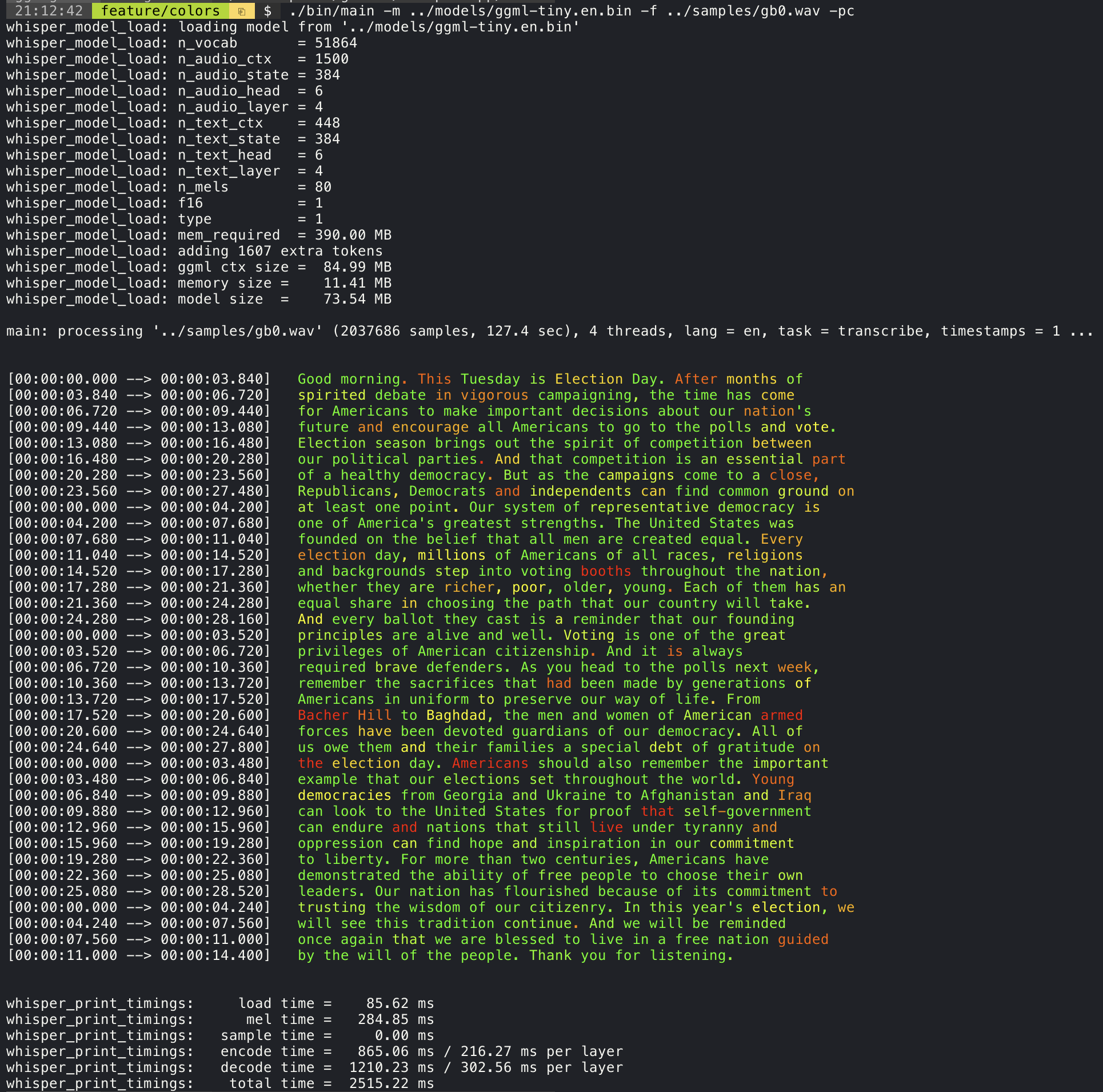
Confidence color-coding
Adding the --print-colors argument will print the transcribed text using an experimental color coding strategy
to highlight words with high or low confidence:
./build/bin/whisper-cli -m models/ggml-base.en.bin -f samples/gb0.wav --print-colors
Controlling the length of the generated text segments (experimental)
For example, to limit the line length to a maximum of 16 characters, simply add -ml 16:
$ ./build/bin/whisper-cli -m ./models/ggml-base.en.bin -f ./samples/jfk.wav -ml 16

whisper_model_load: loading model from './models/ggml-base.en.bin'
...
system_info: n_threads = 4 / 10 | AVX2 = 0 | AVX512 = 0 | NEON = 1 | FP16_VA = 1 | WASM_SIMD = 0 | BLAS = 1 |

main: processing './samples/jfk.wav' (176000 samples, 11.0 sec), 4 threads, 1 processors, lang = en, task = transcribe, timestamps = 1 ...

[00:00:00.000 --> 00:00:00.850]   And so my
[00:00:00.850 --> 00:00:01.590]   fellow
[00:00:01.590 --> 00:00:04.140]   Americans, ask
[00:00:04.140 --> 00:00:05.660]   not what your
[00:00:05.660 --> 00:00:06.840]   country can do
[00:00:06.840 --> 00:00:08.430]   for you, ask
[00:00:08.430 --> 00:00:09.440]   what you can do
[00:00:09.440 --> 00:00:10.020]   for your
[00:00:10.020 --> 00:00:11.000]   country.
Word-level timestamp (experimental)
The --max-len argument can be used to obtain word-level timestamps. Simply use -ml 1:
$ ./build/bin/whisper-cli -m ./models/ggml-base.en.bin -f ./samples/jfk.wav -ml 1

whisper_model_load: loading model from './models/ggml-base.en.bin'
...
system_info: n_threads = 4 / 10 | AVX2 = 0 | AVX512 = 0 | NEON = 1 | FP16_VA = 1 | WASM_SIMD = 0 | BLAS = 1 |

main: processing './samples/jfk.wav' (176000 samples, 11.0 sec), 4 threads, 1 processors, lang = en, task = transcribe, timestamps = 1 ...

[00:00:00.000 --> 00:00:00.320]
[00:00:00.320 --> 00:00:00.370]   And
[00:00:00.370 --> 00:00:00.690]   so
[00:00:00.690 --> 00:00:00.850]   my
[00:00:00.850 --> 00:00:01.590]   fellow
[00:00:01.590 --> 00:00:02.850]   Americans
[00:00:02.850 --> 00:00:03.300]  ,
[00:00:03.300 --> 00:00:04.140]   ask
[00:00:04.140 --> 00:00:04.990]   not
[00:00:04.990 --> 00:00:05.410]   what
[00:00:05.410 --> 00:00:05.660]   your
[00:00:05.660 --> 00:00:06.260]   country
[00:00:06.260 --> 00:00:06.600]   can
[00:00:06.600 --> 00:00:06.840]   do
[00:00:06.840 --> 00:00:07.010]   for
[00:00:07.010 --> 00:00:08.170]   you
[00:00:08.170 --> 00:00:08.190]  ,
[00:00:08.190 --> 00:00:08.430]   ask
[00:00:08.430 --> 00:00:08.910]   what
[00:00:08.910 --> 00:00:09.040]   you
[00:00:09.040 --> 00:00:09.320]   can
[00:00:09.320 --> 00:00:09.440]   do
[00:00:09.440 --> 00:00:09.760]   for
[00:00:09.760 --> 00:00:10.020]   your
[00:00:10.020 --> 00:00:10.510]   country
[00:00:10.510 --> 00:00:11.000]  .
Speaker segmentation via tinydiarize (experimental)
More information about this approach is available here: https://github.com/ggml-org/whisper.cpp/pull/1058
Sample usage:
# download a tinydiarize compatible model
./models/download-ggml-model.sh small.en-tdrz

# run as usual, adding the "-tdrz" command-line argument
./build/bin/whisper-cli -f ./samples/a13.wav -m ./models/ggml-small.en-tdrz.bin -tdrz
...
main: processing './samples/a13.wav' (480000 samples, 30.0 sec), 4 threads, 1 processors, lang = en, task = transcribe, tdrz = 1, timestamps = 1 ...
...
[00:00:00.000 --> 00:00:03.800]   Okay Houston, we've had a problem here. [SPEAKER_TURN]
[00:00:03.800 --> 00:00:06.200]   This is Houston. Say again please. [SPEAKER_TURN]
[00:00:06.200 --> 00:00:08.260]   Uh Houston we've had a problem.
[00:00:08.260 --> 00:00:11.320]   We've had a main beam up on a volt. [SPEAKER_TURN]
[00:00:11.320 --> 00:00:13.820]   Roger main beam interval. [SPEAKER_TURN]
[00:00:13.820 --> 00:00:15.100]   Uh uh [SPEAKER_TURN]
[00:00:15.100 --> 00:00:18.020]   So okay stand, by thirteen we're looking at it. [SPEAKER_TURN]
[00:00:18.020 --> 00:00:25.740]   Okay uh right now uh Houston the uh voltage is uh is looking good um.
[00:00:27.620 --> 00:00:29.940]   And we had a a pretty large bank or so.
Karaoke-style movie generation (experimental)
The whisper-cli example provides support for output of karaoke-style movies, where the
currently pronounced word is highlighted. Use the -owts argument and run the generated bash script.
This requires to have ffmpeg installed.
Here are a few "typical" examples:
./build/bin/whisper-cli -m ./models/ggml-base.en.bin -f ./samples/jfk.wav -owts
source ./samples/jfk.wav.wts
ffplay ./samples/jfk.wav.mp4
https://user-images.githubusercontent.com/1991296/199337465-dbee4b5e-9aeb-48a3-b1c6-323ac4db5b2c.mp4
./build/bin/whisper-cli -m ./models/ggml-base.en.bin -f ./samples/mm0.wav -owts
source ./samples/mm0.wav.wts
ffplay ./samples/mm0.wav.mp4
https://user-images.githubusercontent.com/1991296/199337504-cc8fd233-0cb7-4920-95f9-4227de3570aa.mp4
./build/bin/whisper-cli -m ./models/ggml-base.en.bin -f ./samples/gb0.wav -owts
source ./samples/gb0.wav.wts
ffplay ./samples/gb0.wav.mp4
https://user-images.githubusercontent.com/1991296/199337538-b7b0c7a3-2753-4a88-a0cd-f28a317987ba.mp4
Video comparison of different models
Use the scripts/bench-wts.sh script to generate a video in the following format:
./scripts/bench-wts.sh samples/jfk.wav
ffplay ./samples/jfk.wav.all.mp4
https://user-images.githubusercontent.com/1991296/223206245-2d36d903-cf8e-4f09-8c3b-eb9f9c39d6fc.mp4
Benchmarks
In order to have an objective comparison of the performance of the inference across different system configurations, use the whisper-bench tool. The tool simply runs the Encoder part of the model and prints how much time it took to execute it. The results are summarized in the following Github issue:
Additionally a script to run whisper.cpp with different models and audio files is provided bench.py.
You can run it with the following command, by default it will run against any standard model in the models folder.
python3 scripts/bench.py -f samples/jfk.wav -t 2,4,8 -p 1,2
It is written in python with the intention of being easy to modify and extend for your benchmarking use case.
It outputs a csv file with the results of the benchmarking.
ggml format
The original models are converted to a custom binary format. This allows to pack everything needed into a single file:
- model parameters
- mel filters
- vocabulary
- weights
You can download the converted models using the models/download-ggml-model.sh script or manually from here:
For more details, see the conversion script models/convert-pt-to-ggml.py or models/README.md.
Bindings
- Rust: tazz4843/whisper-rs | #310
- JavaScript: bindings/javascript | #309
- React Native (iOS / Android): whisper.rn
- Go: bindings/go | #312
- Java:
- Ruby: bindings/ruby | #507
- Objective-C / Swift: ggml-org/whisper.spm | #313
- .NET: | #422
- Python: | #9
- stlukey/whispercpp.py (Cython)
- AIWintermuteAI/whispercpp (Updated fork of aarnphm/whispercpp)
- aarnphm/whispercpp (Pybind11)
- abdeladim-s/pywhispercpp (Pybind11)
- R: bnosac/audio.whisper
- Unity: macoron/whisper.unity
XCFramework
The XCFramework is a precompiled version of the library for iOS, visionOS, tvOS, and macOS. It can be used in Swift projects without the need to compile the library from source. For example, the v1.7.5 version of the XCFramework can be used as follows:
// swift-tools-version: 5.10
// The swift-tools-version declares the minimum version of Swift required to build this package.

import PackageDescription

let package = Package(
    name: "Whisper",
    targets: [
        .executableTarget(
            name: "Whisper",
            dependencies: [
                "WhisperFramework"
            ]),
        .binaryTarget(
            name: "WhisperFramework",
            url: "https://github.com/ggml-org/whisper.cpp/releases/download/v1.7.5/whisper-v1.7.5-xcframework.zip",
            checksum: "c7faeb328620d6012e130f3d705c51a6ea6c995605f2df50f6e1ad68c59c6c4a"
        )
    ]
)
Voice Activity Detection (VAD)
Support for Voice Activity Detection (VAD) can be enabled using the --vad
argument to whisper-cli. In addition to this option a VAD model is also
required.
The way this works is that first the audio samples are passed through the VAD model which will detect speech segments. Using this information, only the speech segments that are detected are extracted from the original audio input and passed to whisper for processing. This reduces the amount of audio data that needs to be processed by whisper and can significantly speed up the transcription process.
The following VAD models are currently supported:
Silero-VAD
Silero-vad is a lightweight VAD model written in Python that is fast and accurate.
Models can be downloaded by running the following command on Linux or MacOS:
$ ./models/download-vad-model.sh silero-v6.2.0
Downloading ggml model silero-v6.2.0 from 'https://huggingface.co/ggml-org/whisper-vad' ...
ggml-silero-v6.2.0.bin        100%[==============================================>] 864.35K  --.-KB/s    in 0.04s
Done! Model 'silero-v6.2.0' saved in '/path/models/ggml-silero-v6.2.0.bin'
You can now use it like this:

  $ ./build/bin/whisper-cli -vm /path/models/ggml-silero-v6.2.0.bin --vad -f samples/jfk.wav -m models/ggml-base.en.bin
And the following command on Windows:
> .\models\download-vad-model.cmd silero-v6.2.0
Downloading vad model silero-v6.2.0...
Done! Model silero-v6.2.0 saved in C:\Users\danie\work\ai\whisper.cpp\ggml-silero-v6.2.0.bin
You can now use it like this:

C:\path\build\bin\Release\whisper-cli.exe -vm C:\path\ggml-silero-v6.2.0.bin --vad -m models/ggml-base.en.bin -f samples\jfk.wav
To see a list of all available models, run the above commands without any arguments.
This model can be also be converted manually to ggml using the following command:
$ python3 -m venv venv && source venv/bin/activate
$ (venv) pip install silero-vad
$ (venv) $ python models/convert-silero-vad-to-ggml.py --output models/silero.bin
Saving GGML Silero-VAD model to models/silero-v6.2.0-ggml.bin
And it can then be used with whisper as follows:
$ ./build/bin/whisper-cli \
   --file ./samples/jfk.wav \
   --model ./models/ggml-base.en.bin \
   --vad \
   --vad-model ./models/silero-v6.2.0-ggml.bin
VAD Options
-
--vad-threshold: Threshold probability for speech detection. A probability for a speech segment/frame above this threshold will be considered as speech.
-
--vad-min-speech-duration-ms: Minimum speech duration in milliseconds. Speech segments shorter than this value will be discarded to filter out brief noise or false positives.
-
--vad-min-silence-duration-ms: Minimum silence duration in milliseconds. Silence periods must be at least this long to end a speech segment. Shorter silence periods will be ignored and included as part of the speech.
-
--vad-max-speech-duration-s: Maximum speech duration in seconds. Speech segments longer than this will be automatically split into multiple segments at silence points exceeding 98ms to prevent excessively long segments.
-
--vad-speech-pad-ms: Speech padding in milliseconds. Adds this amount of padding before and after each detected speech segment to avoid cutting off speech edges.
-
--vad-samples-overlap: Amount of audio to extend from each speech segment into the next one, in seconds (e.g., 0.10 = 100ms overlap). This ensures speech isn't cut off abruptly between segments when they're concatenated together.
Examples
There are various examples of using the library for different projects in the examples folder. Some of the examples are even ported to run in the browser using WebAssembly. Check them out!
| Example | Web | Description |
|---|---|---|
| whisper-cli | whisper.wasm | Tool for translating and transcribing audio using Whisper |
| whisper-bench | bench.wasm | Benchmark the performance of Whisper on your machine |
| whisper-stream | stream.wasm | Real-time transcription of raw microphone capture |
| whisper-command | command.wasm | Basic voice assistant example for receiving voice commands from the mic |
| whisper-server | HTTP transcription server with OAI-like API | |
| whisper-talk-llama | Talk with a LLaMA bot | |
| whisper.objc | iOS mobile application using whisper.cpp | |
| whisper.swiftui | SwiftUI iOS / macOS application using whisper.cpp | |
| whisper.android | Android mobile application using whisper.cpp | |
| whisper.nvim | Speech-to-text plugin for Neovim | |
| generate-karaoke.sh | Helper script to easily generate a karaoke video of raw audio capture | |
| livestream.sh | Livestream audio transcription | |
| yt-wsp.sh | Download + transcribe and/or translate any VOD (original) | |
| wchess | wchess.wasm | Voice-controlled chess |
Discussions
If you have any kind of feedback about this project feel free to use the Discussions section and open a new topic.
You can use the Show and tell category
to share your own projects that use whisper.cpp. If you have a question, make sure to check the
Frequently asked questions (#126) discussion.