 scutler-nvandClaude Opus 4.7
7072bdab92
scutler-nvandClaude Opus 4.7
7072bdab92
* ggml-cuda: add internal AllReduce provider for tensor parallelism

Introduces a NCCL-free AllReduce implementation for LLAMA_SPLIT_MODE_TENSOR
using a single-phase CUDA kernel that pipelines D2H copy, cross-GPU
handshake via pinned-memory volatile flags, and the reduction in one
kernel launch per GPU.

New files:
- ggml/src/ggml-cuda/comm.cuh        — ggml_cuda_allreduce_provider enum
- ggml/src/ggml-cuda/allreduce.cuh   — pipeline API declarations
- ggml/src/ggml-cuda/allreduce.cu    — kernel + pipeline init/dispatch

ggml-cuda.cu changes:
- ggml_backend_cuda_comm_context gains ar_pipeline field
- Provider selection via GGML_CUDA_ALLREDUCE env var ("nccl" / "internal")
- INTERNAL provider initialises the pipeline at comm_init time
- Dispatch routes to ggml_cuda_ar_allreduce(); falls back to meta-backend
  CPU reduce for unsupported sizes or GPU counts (> 2)

Current scope: 2 GPUs, FP32, tensors <= 256 KB. Notes in NOTES-allreduce.md.

Co-Authored-By: Claude Sonnet 4.6 <noreply@anthropic.com>

* llama-bench: add --allreduce flag to select AllReduce provider

Adds --allreduce <auto|nccl|internal> to llama-bench (and via the shared
field pattern, consistent with other multi-value flags).  Useful for
isolating hangs or regressions in tensor-parallel mode: pass --allreduce nccl
to force NCCL and bypass the internal provider.

Also fixes ggml_cuda_select_allreduce_provider() to treat an empty
GGML_CUDA_ALLREDUCE env var the same as unset (avoids spurious warning when
llama-bench sets it to "" for the "auto" case).

Co-Authored-By: Claude Sonnet 4.6 <noreply@anthropic.com>
xt gains ar_pipeline field
- Provider selection via GGML_CUDA_ALLREDUCE env var ("nccl" / "internal")
- INTERNAL provider initialises the pipeline at comm_init time
- Dispatch routes to ggml_cuda_ar_allreduce(); falls back to meta-backend
  CPU reduce for unsupported sizes or GPU counts (> 2)

Current scope: 2 GPUs, FP32, tensors <= 256 KB. Notes in NOTES-allreduce.md.

Co-Authored-By: Claude Sonnet 4.6 <noreply@anthropic.com>

* llama-bench: rename --allreduce to --reduction-provider / -rp

Co-Authored-By: Claude Sonnet 4.6 <noreply@anthropic.com>
 via the shared
field pattern, consistent with other multi-value flags).  Useful for
isolating hangs or regressions in tensor-parallel mode: pass --allreduce nccl
to force NCCL and bypass the internal provider.

Also fixes ggml_cuda_select_allreduce_provider() to treat an empty
GGML_CUDA_ALLREDUCE env var the same as unset (avoids spurious warning when
llama-bench sets it to "" for the "auto" case).

Co-Authored-By: Claude Sonnet 4.6 <noreply@anthropic.com>
xt gains ar_pipeline field
- Provider selection via GGML_CUDA_ALLREDUCE env var ("nccl" / "internal")
- INTERNAL provider initialises the pipeline at comm_init time
- Dispatch routes to ggml_cuda_ar_allreduce(); falls back to meta-backend
  CPU reduce for unsupported sizes or GPU counts (> 2)

Current scope: 2 GPUs, FP32, tensors <= 256 KB. Notes in NOTES-allreduce.md.

Co-Authored-By: Claude Sonnet 4.6 <noreply@anthropic.com>

* llama-bench: pass WARN/ERROR log messages through in non-verbose mode

The null log callback was silently dropping all messages. WARN and ERROR
should always be visible since they indicate legitimate issues (e.g. a
requested reduction provider not being available).

Co-Authored-By: Claude Sonnet 4.6 <noreply@anthropic.com>
vider.

Also fixes ggml_cuda_select_allreduce_provider() to treat an empty
GGML_CUDA_ALLREDUCE env var the same as unset (avoids spurious warning when
llama-bench sets it to "" for the "auto" case).

Co-Authored-By: Claude Sonnet 4.6 <noreply@anthropic.com>
xt gains ar_pipeline field
- Provider selection via GGML_CUDA_ALLREDUCE env var ("nccl" / "internal")
- INTERNAL provider initialises the pipeline at comm_init time
- Dispatch routes to ggml_cuda_ar_allreduce(); falls back to meta-backend
  CPU reduce for unsupported sizes or GPU counts (> 2)

Current scope: 2 GPUs, FP32, tensors <= 256 KB. Notes in NOTES-allreduce.md.

Co-Authored-By: Claude Sonnet 4.6 <noreply@anthropic.com>

* cmake: improve NCCL detection for source-tree builds, add static/dynamic switch

FindNCCL.cmake now searches the cmake source-build layout used by the Windows
NCCL port (cmake/lib/Release for static, cmake/src/Release for dynamic import
lib) and also checks src/include for the generated nccl.h header.

New option GGML_CUDA_NCCL_STATIC (default OFF) selects static vs dynamic
linking and controls which paths and library names are searched.

Co-Authored-By: Claude Sonnet 4.6 <noreply@anthropic.com>
 for the "auto" case).

Co-Authored-By: Claude Sonnet 4.6 <noreply@anthropic.com>
xt gains ar_pipeline field
- Provider selection via GGML_CUDA_ALLREDUCE env var ("nccl" / "internal")
- INTERNAL provider initialises the pipeline at comm_init time
- Dispatch routes to ggml_cuda_ar_allreduce(); falls back to meta-backend
  CPU reduce for unsupported sizes or GPU counts (> 2)

Current scope: 2 GPUs, FP32, tensors <= 256 KB. Notes in NOTES-allreduce.md.

Co-Authored-By: Claude Sonnet 4.6 <noreply@anthropic.com>

* ggml-cuda: add AllReduce hang watchdog (GGML_CUDA_AR_WATCHDOG)

When compiled with -DGGML_CUDA_AR_WATCHDOG=ON, uses a debug kernel
variant that writes per-GPU spin diagnostics to pinned host memory.
A host-side blocking poll (cudaEventQuery + volatile reads) detects
hangs and logs WARN with the last observed arrival counters and spin
counts, controlled by GGML_CUDA_AR_WATCHDOG (ms timeout) and
GGML_CUDA_AR_MAX_SPIN (kernel bailout) env vars at runtime.

Zero overhead on the production path — all debug code is behind #ifdef.

Co-Authored-By: Claude Sonnet 4.6 <noreply@anthropic.com>
 ar_pipeline field
- Provider selection via GGML_CUDA_ALLREDUCE env var ("nccl" / "internal")
- INTERNAL provider initialises the pipeline at comm_init time
- Dispatch routes to ggml_cuda_ar_allreduce(); falls back to meta-backend
  CPU reduce for unsupported sizes or GPU counts (> 2)

Current scope: 2 GPUs, FP32, tensors <= 256 KB. Notes in NOTES-allreduce.md.

Co-Authored-By: Claude Sonnet 4.6 <noreply@anthropic.com>

* ggml-cuda: fix intermittent AllReduce hang on Blackwell PCIe

Add __threadfence_system() before the arrival signal write in
signal_set to ensure D2H data is globally visible before the peer
observes the arrival flag.  Without this fence, the peer could enter
Phase 3 host reads before the data had fully landed, causing an
intermittent deadlock on RTX 5090 (Blackwell, PCIe-only).

Also redesign the watchdog from a blocking dispatch-thread poll to a
non-blocking background thread, eliminating the ~20ms per-slot
latency the old design added.

Verified: 30/30 soak test runs clean at ~50 t/s (previously ~1-in-15
hang rate).

Co-Authored-By: Claude Sonnet 4.6 <noreply@anthropic.com>
- INTERNAL provider initialises the pipeline at comm_init time
- Dispatch routes to ggml_cuda_ar_allreduce(); falls back to meta-backend
  CPU reduce for unsupported sizes or GPU counts (> 2)

Current scope: 2 GPUs, FP32, tensors <= 256 KB. Notes in NOTES-allreduce.md.

Co-Authored-By: Claude Sonnet 4.6 <noreply@anthropic.com>

* ggml-cuda: fix watchdog shutdown ordering and pipeline_free drain

- Stop watchdog thread BEFORE destroying GPU resources (events, streams)
  to prevent polling destroyed handles → spurious "busy" readings
- Add cudaStreamSynchronize in pipeline_free to drain in-flight kernels
  before freeing pinned host buffers they may still be reading
- Sleep-first watchdog polling: no +0ms noise, only logs when a kernel
  is genuinely stuck past the poll interval
- Check wdog_stop in both outer and inner loops so join() returns
  promptly instead of draining the entire queue
- Add Phase 3 breadcrumbs to debug[3] for hang localization

Co-Authored-By: Claude Sonnet 4.6 <noreply@anthropic.com>
RNAL provider initialises the pipeline at comm_init time
- Dispatch routes to ggml_cuda_ar_allreduce(); falls back to meta-backend
  CPU reduce for unsupported sizes or GPU counts (> 2)

Current scope: 2 GPUs, FP32, tensors <= 256 KB. Notes in NOTES-allreduce.md.

Co-Authored-By: Claude Sonnet 4.6 <noreply@anthropic.com>

* ggml-cuda: replace event-based watchdog with per-GPU ring buffer

Completely rework the GGML_CUDA_AR_WATCHDOG system:

- Replace the shared debug_buf + event-polling + queue design with
  per-GPU ring buffers in pinned host memory
- Kernel writes a debug record only on spin-limit bailout: claims a
  ring slot via atomicAdd (single-GPU host atomics work on RTX 5090),
  writes fields, fences, sets completion flag, then all threads exit
- Watchdog thread simply polls ring head counters every 1ms and prints
  any new complete records — no CUDA event queries, no mutex, no queue
- Zero overhead on the dispatch path (no queue posting, no memset)
- Watchdog shutdown returns within ~1ms (atomic bool, no drain)
- On bailout the kernel skips Phase 3 entirely and exits cleanly

Verified: 20/20 prefill soak test clean at ~1112 t/s, no hangs.

Co-Authored-By: Claude Sonnet 4.6 <noreply@anthropic.com>
P32, tensors <= 256 KB. Notes in NOTES-allreduce.md.

Co-Authored-By: Claude Sonnet 4.6 <noreply@anthropic.com>

* fix: normalize line endings to LF (undo Windows CRLF conversion)

Five files were inadvertently converted to CRLF by the Windows
development environment, causing every line to show as changed in
diffs against master.

Co-Authored-By: Claude Sonnet 4.6 <noreply@anthropic.com>
imit bailout: claims a
  ring slot via atomicAdd (single-GPU host atomics work on RTX 5090),
  writes fields, fences, sets completion flag, then all threads exit
- Watchdog thread simply polls ring head counters every 1ms and prints
  any new complete records — no CUDA event queries, no mutex, no queue
- Zero overhead on the dispatch path (no queue posting, no memset)
- Watchdog shutdown returns within ~1ms (atomic bool, no drain)
- On bailout the kernel skips Phase 3 entirely and exits cleanly

Verified: 20/20 prefill soak test clean at ~1112 t/s, no hangs.

Co-Authored-By: Claude Sonnet 4.6 <noreply@anthropic.com>
P32, tensors <= 256 KB. Notes in NOTES-allreduce.md.

Co-Authored-By: Claude Sonnet 4.6 <noreply@anthropic.com>

* .gitattributes: force LF line endings to prevent Windows CRLF conversion

Co-Authored-By: Claude Sonnet 4.6 <noreply@anthropic.com>
elopment environment, causing every line to show as changed in
diffs against master.

Co-Authored-By: Claude Sonnet 4.6 <noreply@anthropic.com>
imit bailout: claims a
  ring slot via atomicAdd (single-GPU host atomics work on RTX 5090),
  writes fields, fences, sets completion flag, then all threads exit
- Watchdog thread simply polls ring head counters every 1ms and prints
  any new complete records — no CUDA event queries, no mutex, no queue
- Zero overhead on the dispatch path (no queue posting, no memset)
- Watchdog shutdown returns within ~1ms (atomic bool, no drain)
- On bailout the kernel skips Phase 3 entirely and exits cleanly

Verified: 20/20 prefill soak test clean at ~1112 t/s, no hangs.

Co-Authored-By: Claude Sonnet 4.6 <noreply@anthropic.com>
P32, tensors <= 256 KB. Notes in NOTES-allreduce.md.

Co-Authored-By: Claude Sonnet 4.6 <noreply@anthropic.com>

* ggml-cuda: move GGML_CUDA_AR_WATCHDOG from CMake option to local define

The watchdog is development-only; a global CMake option is overkill.
Move the toggle to a #define at the top of allreduce.cu (set to 0 by
default) and remove the option from ggml/CMakeLists.txt and the CUDA
CMakeLists.txt add_compile_definitions block.

Co-Authored-By: Claude Sonnet 4.6 <noreply@anthropic.com>
 fences, sets completion flag, then all threads exit
- Watchdog thread simply polls ring head counters every 1ms and prints
  any new complete records — no CUDA event queries, no mutex, no queue
- Zero overhead on the dispatch path (no queue posting, no memset)
- Watchdog shutdown returns within ~1ms (atomic bool, no drain)
- On bailout the kernel skips Phase 3 entirely and exits cleanly

Verified: 20/20 prefill soak test clean at ~1112 t/s, no hangs.

Co-Authored-By: Claude Sonnet 4.6 <noreply@anthropic.com>
P32, tensors <= 256 KB. Notes in NOTES-allreduce.md.

Co-Authored-By: Claude Sonnet 4.6 <noreply@anthropic.com>

* unify kernel debug paths

* use __threadfence_system explicitly (not in ggml_cuda_ar_signal_set)

* preferentially use internal reduction for <=2 GPUs

* templatize the main kernel to support fp16/bf16

* restore llama-bench.cpp changes

* revert CMakeLists changes

* remove notes from repo

* remove dead warmup code

* fix comments

* improve reduction provider fallback code

* add messages for allreduce fallback

* rework reduction provider init to not call ncclCommInitAll if using the internal provider

* fix case where a given tensor has not been computed

* add chunked mode to the kernel for unlimited vector size

* rework a few checks/fallbacks

* various small cleanups

* allow disabling CUDA reductions completely (falling back to the non-CUDA butterfly mode)

* simplify reduction provider selection

* minor simplifications

* more cleanups/fixes

* prototype alternate path for large reductions

* chunked version of large reduction path

* use bf16 for large reductions

* experimental reduction using cudaMemcpyPeerAsync (slightly slower)

* revert experimental change

* add combined conversion/reduction kernel

* add bf16 wire format for single kernel mode

* experimental on-stream small reduction kernel

* double buffer arrival slots, use token (incrementing) method

* double buffer host_buf for small reductions

* put in waits for use of host_mem in large reduction case (prevents stomping on in-use memory

* remove watchdog code

* various cleanups / dead code removal

* fix fp16 mode

* fix some comments/logging statements

* use increasing token scheme for arrival signals

* add top-level comment to allreduce.cu

* improve top-level comment in allreduce.cu

* fix comments in ggml_cuda_ar_kernel

* improve event handling for hostmem buffer usage tracking

* change ev_pool to fixed 2D array

* add chunked memcpy fallback for extra-large reductions (>32 MB)

* change thresholds for copy-engine path and bf16 demotion

* multi-block kernel test

* more fine-tuning for chukn-size, etc.

* various fixes for PR review

* more PR fixes

* fix semantics of all host mappings

* require ampere+

* small cleanups

* properly use host pointer for src/dst in cudaMemcpy calls

* allreduce: lazy-init the internal pipeline on first use

A config that lives entirely on NCCL never needs the chunked-kernel
pipeline (host_buf, host_large, dev_tmp, streams, events, arrival ring).
Defer pipeline creation to the first try_allreduce_internal call using the
same std::call_once pattern as ensure_nccl, so those resources stay
unallocated when only NCCL is in use.

Co-Authored-By: Claude Opus 4.7 (1M context) <noreply@anthropic.com>

* allreduce: assert n_backends == 2 instead of soft-fallback

ar_pipeline_init already requires n_devices == 2 and bails before any AR can
get here, so by the time we reach try_allreduce_internal we know we have
exactly two backends.  Replace the runtime-debug-log fallback with a hard
assert.

Co-Authored-By: Claude Opus 4.7 (1M context) <noreply@anthropic.com>
 NCCL is in use.

Co-Authored-By: Claude Opus 4.7 (1M context) <noreply@anthropic.com>

* rework reduction provider selection. internal/nccl is OS dependent; most fallbacks are removed

* remove unneeded Turing arch check (llama.cpp doesn't even compile pre-Turing anyway)

* allreduce: ASCII-only comments and ggml_cuda_cast for value conversions

Replace non-ASCII characters in comments (em dashes, right arrows) with
ASCII equivalents (--, ->) so the source stays in the ggml/upstream norm.

In the kernel-side code, replace static_cast<Twire>/static_cast<Tdst>
with ggml_cuda_cast<...> so the BF16 conversions go through the fast
__float2bfloat16 / __bfloat162float intrinsics from convert.cuh.  Pure
pointer and integer casts stay as static_cast.

Also drops two stray garbage tokens that snuck in from earlier merges
(a duplicated 'return ok; }' tail in allreduce.cu and a leftover '_reg)'
fragment in ggml-cuda.cu).

Co-Authored-By: Claude Opus 4.7 (1M context) <noreply@anthropic.com>

* allreduce: use ggml_cuda_memcpy_1 for the chunked-kernel vector copies

The chunked kernel's two 16-byte register<->host transfers (Phase 1 store
and Phase 3 load) used reinterpret_cast<float4 *> on both sides.  Replace
with ggml_cuda_memcpy_1<sizeof(wire)>, which is the canonical helper for
this pattern and emits the same int4 LD/ST under the hood.

Conformance passes; 5x reruns of 70b internal pp512 show 1832-1836 t/s,
matching the prior matrix value of 1831 t/s -- no perf change as expected.

Co-Authored-By: Claude Opus 4.7 (1M context) <noreply@anthropic.com>
ok; }' tail in allreduce.cu and a leftover '_reg)'
fragment in ggml-cuda.cu).

Co-Authored-By: Claude Opus 4.7 (1M context) <noreply@anthropic.com>

* allreduce: assert cuda_ctx->device matches the pipeline's device

Both ggml_cuda_ar_pipeline and ggml_backend_cuda_context carry the device
they were created for; if they ever disagree, every cuda call that follows
runs on the wrong device.  Add GGML_ASSERT at each cuda_ctx retrieval site
in the AR path so the misuse fails fast rather than silently corrupting.

Also: rename __nv_bfloat16 -> nv_bfloat16 (typedef alias) for consistency
with the rest of the file, and tighten one cudaGetLastError check to fire
only after the to_bf16 call that can actually fail.

Co-Authored-By: Claude Opus 4.7 (1M context) <noreply@anthropic.com>
gml-cuda.cu).

Co-Authored-By: Claude Opus 4.7 (1M context) <noreply@anthropic.com>

* allreduce: expand one-liner for loops to braced bodies

Code-style preference -- match the rest of the file by writing every for
loop with the body on its own braced line.  Three sites in the copy-engine
typed dispatch.

Co-Authored-By: Claude Opus 4.7 (1M context) <noreply@anthropic.com>
in the AR path so the misuse fails fast rather than silently corrupting.

Also: rename __nv_bfloat16 -> nv_bfloat16 (typedef alias) for consistency
with the rest of the file, and tighten one cudaGetLastError check to fire
only after the to_bf16 call that can actually fail.

Co-Authored-By: Claude Opus 4.7 (1M context) <noreply@anthropic.com>
gml-cuda.cu).

Co-Authored-By: Claude Opus 4.7 (1M context) <noreply@anthropic.com>

* allreduce: rename template parameters Tdst/Twire/Tsrc -> T_dst/T_wire/T_src

Code-style preference per PR review -- T_dst/T_wire/T_src is more
consistent with surrounding code.  Whole-word rename across all 58 sites
in allreduce.cu (kernel definitions, internal uses, and comment text).

Realigned the parameter columns in three function signatures whose
T_src/T_dst lines shifted by 1 char relative to their non-templated
neighbors.

Co-Authored-By: Claude Opus 4.7 (1M context) <noreply@anthropic.com>
to fire
only after the to_bf16 call that can actually fail.

Co-Authored-By: Claude Opus 4.7 (1M context) <noreply@anthropic.com>
gml-cuda.cu).

Co-Authored-By: Claude Opus 4.7 (1M context) <noreply@anthropic.com>

* allreduce: drop hyphen in 'chunked-kernel' across comments

Per PR review feedback -- 'chunked kernel' (no hyphen) reads more naturally
in running prose, especially for ESL readers.  Pure comment-only change;
all 10 occurrences in allreduce.cu updated.

Co-Authored-By: Claude Opus 4.7 (1M context) <noreply@anthropic.com>
three function signatures whose
T_src/T_dst lines shifted by 1 char relative to their non-templated
neighbors.

Co-Authored-By: Claude Opus 4.7 (1M context) <noreply@anthropic.com>
to fire
only after the to_bf16 call that can actually fail.

Co-Authored-By: Claude Opus 4.7 (1M context) <noreply@anthropic.com>
gml-cuda.cu).

Co-Authored-By: Claude Opus 4.7 (1M context) <noreply@anthropic.com>

* allreduce: use ggml_cuda_get_max_cpy_bytes() instead of hardcoded 16

The chunked kernel hardcoded a 16-byte vector unit; replace with the
ggml_cuda_get_max_cpy_bytes() helper that fattn-common.cuh uses for the
same purpose, so ELEMS_PER_VEC self-adjusts to the arch's widest
single-instruction copy.

Perf-neutral on supported targets (Volta+ returns 16).

Co-Authored-By: Claude Opus 4.7 (1M context) <noreply@anthropic.com>
hbors.

Co-Authored-By: Claude Opus 4.7 (1M context) <noreply@anthropic.com>
to fire
only after the to_bf16 call that can actually fail.

Co-Authored-By: Claude Opus 4.7 (1M context) <noreply@anthropic.com>
gml-cuda.cu).

Co-Authored-By: Claude Opus 4.7 (1M context) <noreply@anthropic.com>

* ggml-cuda: PR review fixes -- annotate #endif, fix stale comment, assert nbytes alignment

Three separate but minor changes from PR #22299 review feedback:

1. Annotate the five GGML_USE_NCCL #endif lines with the matching condition
   so the pairing is visible without scrolling back.

2. The comment block on ggml_backend_cuda_comm_context claimed NCCL is
   lazy-initialised; that was true at one point but the dispatch refactor
   (727b141c0) made both NCCL and the internal pipeline eager.  Rewrite
   the comment to match current behaviour.

3. Assert in ggml_backend_cuda_comm_allreduce_internal that the tensor's
   byte size is a 16-byte multiple.  The chunked-kernel issues full-width
   vector loads/stores, so this is a precondition; tensor-parallel splits
   of hidden-dim-multiples satisfy it trivially, but a hard assert turns
   any caller-side bug into a clear failure rather than UB.

Co-Authored-By: Claude Opus 4.7 (1M context) <noreply@anthropic.com>
 device's new AR
records its ev.ker -- otherwise the second device's wait sees the first
device's just-recorded event (the in-flight new AR) and creates a circular
dependency with the in-kernel peer signal.  Two-pass dispatch (all waits,
then all launches) avoids this.

Bump POOL_SIZE 2 -> 8 (small memory cost, more breathing room for the
GPU's view of the event chain) and add a runtime env override for the
hybrid kernel chunk size (GGML_CUDA_AR_HYBRID_CHUNK_BYTES) for tuning.
One-shot stderr diagnostic at first AR prints the chosen path + sizing.

Result on 2x RTX 5090 Linux, 70b ub_sweep:

    ub=64   (1 MB AR): 913 -> 1036 t/s  (+13.5% vs old, +1.8% vs NCCL)
    ub=128  (2 MB AR): 1056 -> 1181     (+11.9%, +3.7% vs NCCL)
    ub=256  (4 MB AR): 1212 -> 1424     (+17.5%, +3.5% vs NCCL)

Internal now beats NCCL at every size (+1.8% to +15.6%), recovering all
ground in the 1-4 MB regime that was previously a 10-12% loss.

Co-Authored-By: Claude Opus 4.7 (1M context) <noreply@anthropic.com>

* simplify the init logic

* address some other PR requests

* ggml-cuda: stub internal AllReduce on HIP/MUSA, drop pre-Ampere mention, gate NCCL fallback warning on !HIP

The internal AllReduce relies on cudaHostAllocPortable/Mapped,
cudaHostGetDevicePointer, and __nanosleep -- none of which the HIP or
MUSA shims expose -- so wrap the implementation in
!defined(GGML_USE_HIP) && !defined(GGML_USE_MUSA) and provide
nullptr/no-op/false stubs in the #else branch.  The dispatcher already
treats a null pipeline as init failure and silently falls back to the
meta backend's generic AllReduce, so HIP/MUSA builds compile clean and
behave correctly without further call-site changes.

PR review follow-ups:
 - drop "or pre-Ampere?" from the internal-init failure warning -- the
   kernel doesn't require Ampere or newer.
 - guard the "NCCL not compiled in" fallback warning behind
   !defined(GGML_USE_HIP); the suggestion to install NCCL only makes
   sense on NVIDIA builds.

Co-Authored-By: Claude Opus 4.7 (1M context) <noreply@anthropic.com>
hind, now +6-8% ahead at ub=1024-4096.
Perplexity (32 chunks) matches NCCL bit-for-bit (3.4044 vs 3.4043).

Co-Authored-By: Claude Opus 4.7 (1M context) <noreply@anthropic.com>

* allreduce: guard __nanosleep on Volta+ and reject pre-Volta devices at init

__nanosleep is the only Volta-specific intrinsic in the kernel; wrap it
in #if __CUDA_ARCH__ >= GGML_CUDA_CC_VOLTA / NO_DEVICE_CODE so the file
still compiles cleanly when targeting older arches (the dispatcher's
init check below ensures the kernel is never actually launched on
pre-Volta).

Add a per-device compute-capability check in pipeline_init that returns
nullptr if any device is below sm70.  The dispatcher already treats
nullptr as init failure and silently falls back to the meta backend's
generic AllReduce.

Co-Authored-By: Claude Opus 4.7 (1M context) <noreply@anthropic.com>
rom the internal-init failure warning -- the
   kernel doesn't require Ampere or newer.
 - guard the "NCCL not compiled in" fallback warning behind
   !defined(GGML_USE_HIP); the suggestion to install NCCL only makes
   sense on NVIDIA builds.

Co-Authored-By: Claude Opus 4.7 (1M context) <noreply@anthropic.com>
hind, now +6-8% ahead at ub=1024-4096.
Perplexity (32 chunks) matches NCCL bit-for-bit (3.4044 vs 3.4043).

Co-Authored-By: Claude Opus 4.7 (1M context) <noreply@anthropic.com>

* allreduce: fix CI -Werror warnings (sign-compare, format, restrict alias, maybe-uninitialized)

The CUDA CI builds with -Werror -Wsign-compare -Wformat -Wrestrict
-Wmaybe-uninitialized.  Address each:

 - n_devices is size_t; change `int i; i < n_devices` to size_t in the
   three init loops, and the matching GGML_LOG_INFO format from %d to %zu.
 - ggml_cuda_ar_kernel was launched with sendbuf == recvbuf (in-place
   reduction), so the __restrict__ qualifiers on those parameters were
   technically UB.  Drop __restrict__ from sendbuf and recvbuf; an A/B
   sweep showed <0.6% perf delta (within noise) on Linux.
 - The buf/src/dst pointer arrays in ggml_cuda_ar_allreduce and the
   per-iteration arrays in ggml_cuda_ar_allreduce_copy_outer were
   declared with size GGML_CUDA_MAX_DEVICES but the loop only writes
   indices [0, n_devices); zero-initialise so the compiler sees the
   tail elements as defined.

Co-Authored-By: Claude Opus 4.7 (1M context) <noreply@anthropic.com>
now +6-8% ahead at ub=1024-4096.
Perplexity (32 chunks) matches NCCL bit-for-bit (3.4044 vs 3.4043).

Co-Authored-By: Claude Opus 4.7 (1M context) <noreply@anthropic.com>

* ggml-cuda: drop unused-function warning by guarding try_allreduce_nccl behind GGML_USE_NCCL

The only call site (in init_nccl) is already inside #ifdef GGML_USE_NCCL,
so the function is unreferenced in non-NCCL builds and trips
nvcc's -Werror=unused-function check.  Move the guard from inside the
function body to around the entire definition.

Co-Authored-By: Claude Opus 4.7 (1M context) <noreply@anthropic.com>
ce
   reduction), so the __restrict__ qualifiers on those parameters were
   technically UB.  Drop __restrict__ from sendbuf and recvbuf; an A/B
   sweep showed <0.6% perf delta (within noise) on Linux.
 - The buf/src/dst pointer arrays in ggml_cuda_ar_allreduce and the
   per-iteration arrays in ggml_cuda_ar_allreduce_copy_outer were
   declared with size GGML_CUDA_MAX_DEVICES but the loop only writes
   indices [0, n_devices); zero-initialise so the compiler sees the
   tail elements as defined.

Co-Authored-By: Claude Opus 4.7 (1M context) <noreply@anthropic.com>
now +6-8% ahead at ub=1024-4096.
Perplexity (32 chunks) matches NCCL bit-for-bit (3.4044 vs 3.4043).

Co-Authored-By: Claude Opus 4.7 (1M context) <noreply@anthropic.com>

---------

Co-authored-by: Claude Sonnet 4.6 <noreply@anthropic.com>
whisper.cpp


High-performance inference of OpenAI's Whisper automatic speech recognition (ASR) model:
- Plain C/C++ implementation without dependencies
- Apple Silicon first-class citizen - optimized via ARM NEON, Accelerate framework, Metal and Core ML
- AVX intrinsics support for x86 architectures
- VSX intrinsics support for POWER architectures
- Mixed F16 / F32 precision
- Integer quantization support
- Zero memory allocations at runtime
- Vulkan support
- Support for CPU-only inference
- Efficient GPU support for NVIDIA
- OpenVINO Support
- Ascend NPU Support
- Moore Threads GPU Support
- C-style API
- Voice Activity Detection (VAD)
Supported platforms:
- Mac OS (Intel and Arm)
- iOS
- Android
- Java
- Linux / FreeBSD
- WebAssembly
- Windows (MSVC and MinGW)
- Raspberry Pi
- Docker
The entire high-level implementation of the model is contained in whisper.h and whisper.cpp.
The rest of the code is part of the ggml machine learning library.
Having such a lightweight implementation of the model allows to easily integrate it in different platforms and applications. As an example, here is a video of running the model on an iPhone 13 device - fully offline, on-device: whisper.objc
https://user-images.githubusercontent.com/1991296/197385372-962a6dea-bca1-4d50-bf96-1d8c27b98c81.mp4
You can also easily make your own offline voice assistant application: command
https://user-images.githubusercontent.com/1991296/204038393-2f846eae-c255-4099-a76d-5735c25c49da.mp4
On Apple Silicon, the inference runs fully on the GPU via Metal:
https://github.com/ggml-org/whisper.cpp/assets/1991296/c82e8f86-60dc-49f2-b048-d2fdbd6b5225
Quick start
First clone the repository:
git clone https://github.com/ggml-org/whisper.cpp.git
Navigate into the directory:
cd whisper.cpp
Then, download one of the Whisper models converted in ggml format. For example:
sh ./models/download-ggml-model.sh base.en
Now build the whisper-cli example and transcribe an audio file like this:
# build the project
cmake -B build
cmake --build build -j --config Release

# transcribe an audio file
./build/bin/whisper-cli -f samples/jfk.wav
For a quick demo, simply run make base.en.
The command downloads the base.en model converted to custom ggml format and runs the inference on all .wav samples in the folder samples.
For detailed usage instructions, run: ./build/bin/whisper-cli -h
Note that the whisper-cli example currently runs only with 16-bit WAV files, so make sure to convert your input before running the tool.
For example, you can use ffmpeg like this:
ffmpeg -i input.mp3 -ar 16000 -ac 1 -c:a pcm_s16le output.wav
More audio samples
If you want some extra audio samples to play with, simply run:
make -j samples
This will download a few more audio files from Wikipedia and convert them to 16-bit WAV format via ffmpeg.
You can download and run the other models as follows:
make -j tiny.en
make -j tiny
make -j base.en
make -j base
make -j small.en
make -j small
make -j medium.en
make -j medium
make -j large-v1
make -j large-v2
make -j large-v3
make -j large-v3-turbo
Memory usage
| Model | Disk | Mem |
|---|---|---|
| tiny | 75 MiB | ~273 MB |
| base | 142 MiB | ~388 MB |
| small | 466 MiB | ~852 MB |
| medium | 1.5 GiB | ~2.1 GB |
| large | 2.9 GiB | ~3.9 GB |
POWER VSX Intrinsics
whisper.cpp supports POWER architectures and includes code which
significantly speeds operation on Linux running on POWER9/10, making it
capable of faster-than-realtime transcription on underclocked Raptor
Talos II. Ensure you have a BLAS package installed, and replace the
standard cmake setup with:
# build with GGML_BLAS defined
cmake -B build -DGGML_BLAS=1
cmake --build build -j --config Release
./build/bin/whisper-cli [ .. etc .. ]
Quantization
whisper.cpp supports integer quantization of the Whisper ggml models.
Quantized models require less memory and disk space and depending on the hardware can be processed more efficiently.
Here are the steps for creating and using a quantized model:
# quantize a model with Q5_0 method
cmake -B build
cmake --build build -j --config Release
./build/bin/quantize models/ggml-base.en.bin models/ggml-base.en-q5_0.bin q5_0

# run the examples as usual, specifying the quantized model file
./build/bin/whisper-cli -m models/ggml-base.en-q5_0.bin ./samples/gb0.wav
Core ML support
On Apple Silicon devices, the Encoder inference can be executed on the Apple Neural Engine (ANE) via Core ML. This can result in significant
speed-up - more than x3 faster compared with CPU-only execution. Here are the instructions for generating a Core ML model and using it with whisper.cpp:
-
Install Python dependencies needed for the creation of the Core ML model:
pip install ane_transformers pip install openai-whisper pip install coremltools- To ensure
coremltoolsoperates correctly, please confirm that Xcode is installed and executexcode-select --installto install the command-line tools. - Python 3.11 is recommended.
- MacOS Sonoma (version 14) or newer is recommended, as older versions of MacOS might experience issues with transcription hallucination.
- [OPTIONAL] It is recommended to utilize a Python version management system, such as Miniconda for this step:
- To create an environment, use:
conda create -n py311-whisper python=3.11 -y - To activate the environment, use:
conda activate py311-whisper
- To create an environment, use:
- To ensure
-
Generate a Core ML model. For example, to generate a
base.enmodel, use:./models/generate-coreml-model.sh base.enThis will generate the folder
models/ggml-base.en-encoder.mlmodelc -
Build
whisper.cppwith Core ML support:# using CMake cmake -B build -DWHISPER_COREML=1 cmake --build build -j --config Release -
Run the examples as usual. For example:
$ ./build/bin/whisper-cli -m models/ggml-base.en.bin -f samples/jfk.wav

...

whisper_init_state: loading Core ML model from 'models/ggml-base.en-encoder.mlmodelc'
whisper_init_state: first run on a device may take a while ...
whisper_init_state: Core ML model loaded

system_info: n_threads = 4 / 10 | AVX = 0 | AVX2 = 0 | AVX512 = 0 | FMA = 0 | NEON = 1 | ARM_FMA = 1 | F16C = 0 | FP16_VA = 1 | WASM_SIMD = 0 | BLAS = 1 | SSE3 = 0 | VSX = 0 | COREML = 1 |

...
The first run on a device is slow, since the ANE service compiles the Core ML model to some device-specific format. Next runs are faster.
For more information about the Core ML implementation please refer to PR #566.
OpenVINO support
On platforms that support OpenVINO, the Encoder inference can be executed on OpenVINO-supported devices including x86 CPUs and Intel GPUs (integrated & discrete).
This can result in significant speedup in encoder performance. Here are the instructions for generating the OpenVINO model and using it with whisper.cpp:
-
First, setup python virtual env. and install python dependencies. Python 3.10 is recommended.
Windows:
cd models
python -m venv openvino_conv_env
openvino_conv_env\Scripts\activate
python -m pip install --upgrade pip
pip install -r requirements-openvino.txt
Linux and macOS:
cd models python3 -m venv openvino_conv_env source openvino_conv_env/bin/activate python -m pip install --upgrade pip pip install -r requirements-openvino.txt -
Generate an OpenVINO encoder model. For example, to generate a
base.enmodel, use:python convert-whisper-to-openvino.py --model base.enThis will produce ggml-base.en-encoder-openvino.xml/.bin IR model files. It's recommended to relocate these to the same folder as
ggmlmodels, as that is the default location that the OpenVINO extension will search at runtime. -
Build
whisper.cppwith OpenVINO support:Download OpenVINO package from release page. The recommended version to use is 2024.6.0. Ready to use Binaries of the required libraries can be found in the OpenVino Archives
After downloading & extracting package onto your development system, set up required environment by sourcing setupvars script. For example:
Linux:
source /path/to/l_openvino_toolkit_ubuntu22_2023.0.0.10926.b4452d56304_x86_64/setupvars.shWindows (cmd):
C:\Path\To\w_openvino_toolkit_windows_2023.0.0.10926.b4452d56304_x86_64\setupvars.batAnd then build the project using cmake:
cmake -B build -DWHISPER_OPENVINO=1 cmake --build build -j --config Release -
Run the examples as usual. For example:
$ ./build/bin/whisper-cli -m models/ggml-base.en.bin -f samples/jfk.wav

...

whisper_ctx_init_openvino_encoder: loading OpenVINO model from 'models/ggml-base.en-encoder-openvino.xml'
whisper_ctx_init_openvino_encoder: first run on a device may take a while ...
whisper_openvino_init: path_model = models/ggml-base.en-encoder-openvino.xml, device = GPU, cache_dir = models/ggml-base.en-encoder-openvino-cache
whisper_ctx_init_openvino_encoder: OpenVINO model loaded

system_info: n_threads = 4 / 8 | AVX = 1 | AVX2 = 1 | AVX512 = 0 | FMA = 1 | NEON = 0 | ARM_FMA = 0 | F16C = 1 | FP16_VA = 0 | WASM_SIMD = 0 | BLAS = 0 | SSE3 = 1 | VSX = 0 | COREML = 0 | OPENVINO = 1 |

...
The first time run on an OpenVINO device is slow, since the OpenVINO framework will compile the IR (Intermediate Representation) model to a device-specific 'blob'. This device-specific blob will get cached for the next run.
For more information about the OpenVINO implementation please refer to PR #1037.
NVIDIA GPU support
With NVIDIA cards the processing of the models is done efficiently on the GPU via cuBLAS and custom CUDA kernels.
First, make sure you have installed cuda: https://developer.nvidia.com/cuda-downloads
Now build whisper.cpp with CUDA support:
cmake -B build -DGGML_CUDA=1
cmake --build build -j --config Release
or for newer NVIDIA GPU's (RTX 5000 series):
cmake -B build -DGGML_CUDA=1 -DCMAKE_CUDA_ARCHITECTURES="86"
cmake --build build -j --config Release
Vulkan GPU support
Cross-vendor solution which allows you to accelerate workload on your GPU. First, make sure your graphics card driver provides support for Vulkan API.
Now build whisper.cpp with Vulkan support:
cmake -B build -DGGML_VULKAN=1
cmake --build build -j --config Release
BLAS CPU support via OpenBLAS
Encoder processing can be accelerated on the CPU via OpenBLAS.
First, make sure you have installed openblas: https://www.openblas.net/
Now build whisper.cpp with OpenBLAS support:
cmake -B build -DGGML_BLAS=1
cmake --build build -j --config Release
Ascend NPU support
Ascend NPU provides inference acceleration via CANN and AI cores.
First, check if your Ascend NPU device is supported:
Verified devices
| Ascend NPU | Status |
|---|---|
| Atlas 300T A2 | Support |
| Atlas 300I Duo | Support |
Then, make sure you have installed CANN toolkit . The lasted version of CANN is recommanded.
Now build whisper.cpp with CANN support:
cmake -B build -DGGML_CANN=1
cmake --build build -j --config Release
Run the inference examples as usual, for example:
./build/bin/whisper-cli -f samples/jfk.wav -m models/ggml-base.en.bin -t 8
Notes:
- If you have trouble with Ascend NPU device, please create a issue with [CANN] prefix/tag.
- If you run successfully with your Ascend NPU device, please help update the table
Verified devices.
Moore Threads GPU support
With Moore Threads cards the processing of the models is done efficiently on the GPU via muBLAS and custom MUSA kernels.
First, make sure you have installed MUSA SDK rc4.2.0: https://developer.mthreads.com/sdk/download/musa?equipment=&os=&driverVersion=&version=4.2.0
Now build whisper.cpp with MUSA support:
cmake -B build -DGGML_MUSA=1
cmake --build build -j --config Release
or specify the architecture for your Moore Threads GPU. For example, if you have a MTT S80 GPU, you can specify the architecture as follows:
cmake -B build -DGGML_MUSA=1 -DMUSA_ARCHITECTURES="21"
cmake --build build -j --config Release
FFmpeg support (Linux only)
If you want to support more audio formats (such as Opus and AAC), you can turn on the WHISPER_FFMPEG build flag to enable FFmpeg integration.
First, you need to install required libraries:
# Debian/Ubuntu
sudo apt install libavcodec-dev libavformat-dev libavutil-dev

# RHEL/Fedora
sudo dnf install libavcodec-free-devel libavformat-free-devel libavutil-free-devel
Then you can build the project as follows:
cmake -B build -D WHISPER_FFMPEG=yes
cmake --build build
Run the following example to confirm it's working:
# Convert an audio file to Opus format
ffmpeg -i samples/jfk.wav jfk.opus

# Transcribe the audio file
./build/bin/whisper-cli --model models/ggml-base.en.bin --file jfk.opus
Docker
Prerequisites
- Docker must be installed and running on your system.
- Create a folder to store big models & intermediate files (ex. /whisper/models)
Images
We have multiple Docker images available for this project:
ghcr.io/ggml-org/whisper.cpp:main: This image includes the main executable file as well ascurlandffmpeg. (platforms:linux/amd64,linux/arm64)ghcr.io/ggml-org/whisper.cpp:main-cuda: Same asmainbut compiled with CUDA support. (platforms:linux/amd64)ghcr.io/ggml-org/whisper.cpp:main-musa: Same asmainbut compiled with MUSA support. (platforms:linux/amd64)ghcr.io/ggml-org/whisper.cpp:main-vulkan: Same asmainbut compiled with Vulkan support. (platforms:linux/amd64)
Usage
# download model and persist it in a local folder
docker run -it --rm \
  -v path/to/models:/models \
  whisper.cpp:main "./models/download-ggml-model.sh base /models"

# transcribe an audio file
docker run -it --rm \
  -v path/to/models:/models \
  -v path/to/audios:/audios \
  whisper.cpp:main "whisper-cli -m /models/ggml-base.bin -f /audios/jfk.wav"

# transcribe an audio file in samples folder
docker run -it --rm \
  -v path/to/models:/models \
  whisper.cpp:main "whisper-cli -m /models/ggml-base.bin -f ./samples/jfk.wav"

# run the web server
docker run -it --rm -p "8080:8080" \
  -v path/to/models:/models \
  whisper.cpp:main "whisper-server --host 127.0.0.1 -m /models/ggml-base.bin"

# run the bench too on the small.en model using 4 threads
docker run -it --rm \
  -v path/to/models:/models \
  whisper.cpp:main "whisper-bench -m /models/ggml-small.en.bin -t 4"
Installing with Conan
You can install pre-built binaries for whisper.cpp or build it from source using Conan. Use the following command:
conan install --requires="whisper-cpp/[*]" --build=missing
For detailed instructions on how to use Conan, please refer to the Conan documentation.
Limitations
- Inference only
Real-time audio input example
This is a naive example of performing real-time inference on audio from your microphone. The stream tool samples the audio every half a second and runs the transcription continuously. More info is available in issue #10. You will need to have sdl2 installed for it to work properly.
cmake -B build -DWHISPER_SDL2=ON
cmake --build build -j --config Release
./build/bin/whisper-stream -m ./models/ggml-base.en.bin -t 8 --step 500 --length 5000
https://user-images.githubusercontent.com/1991296/194935793-76afede7-cfa8-48d8-a80f-28ba83be7d09.mp4
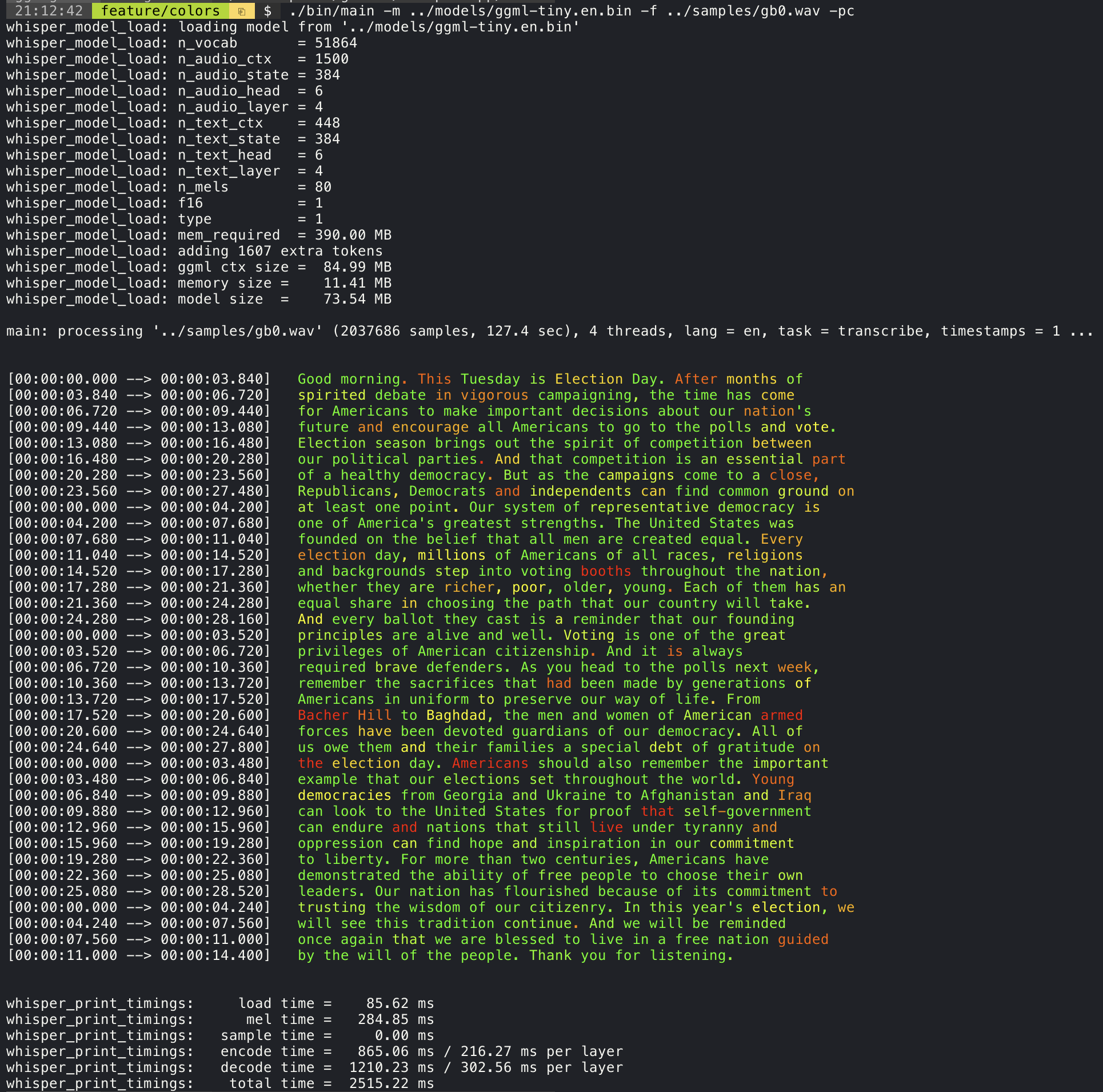
Confidence color-coding
Adding the --print-colors argument will print the transcribed text using an experimental color coding strategy
to highlight words with high or low confidence:
./build/bin/whisper-cli -m models/ggml-base.en.bin -f samples/gb0.wav --print-colors
Controlling the length of the generated text segments (experimental)
For example, to limit the line length to a maximum of 16 characters, simply add -ml 16:
$ ./build/bin/whisper-cli -m ./models/ggml-base.en.bin -f ./samples/jfk.wav -ml 16

whisper_model_load: loading model from './models/ggml-base.en.bin'
...
system_info: n_threads = 4 / 10 | AVX2 = 0 | AVX512 = 0 | NEON = 1 | FP16_VA = 1 | WASM_SIMD = 0 | BLAS = 1 |

main: processing './samples/jfk.wav' (176000 samples, 11.0 sec), 4 threads, 1 processors, lang = en, task = transcribe, timestamps = 1 ...

[00:00:00.000 --> 00:00:00.850]   And so my
[00:00:00.850 --> 00:00:01.590]   fellow
[00:00:01.590 --> 00:00:04.140]   Americans, ask
[00:00:04.140 --> 00:00:05.660]   not what your
[00:00:05.660 --> 00:00:06.840]   country can do
[00:00:06.840 --> 00:00:08.430]   for you, ask
[00:00:08.430 --> 00:00:09.440]   what you can do
[00:00:09.440 --> 00:00:10.020]   for your
[00:00:10.020 --> 00:00:11.000]   country.
Word-level timestamp (experimental)
The --max-len argument can be used to obtain word-level timestamps. Simply use -ml 1:
$ ./build/bin/whisper-cli -m ./models/ggml-base.en.bin -f ./samples/jfk.wav -ml 1

whisper_model_load: loading model from './models/ggml-base.en.bin'
...
system_info: n_threads = 4 / 10 | AVX2 = 0 | AVX512 = 0 | NEON = 1 | FP16_VA = 1 | WASM_SIMD = 0 | BLAS = 1 |

main: processing './samples/jfk.wav' (176000 samples, 11.0 sec), 4 threads, 1 processors, lang = en, task = transcribe, timestamps = 1 ...

[00:00:00.000 --> 00:00:00.320]
[00:00:00.320 --> 00:00:00.370]   And
[00:00:00.370 --> 00:00:00.690]   so
[00:00:00.690 --> 00:00:00.850]   my
[00:00:00.850 --> 00:00:01.590]   fellow
[00:00:01.590 --> 00:00:02.850]   Americans
[00:00:02.850 --> 00:00:03.300]  ,
[00:00:03.300 --> 00:00:04.140]   ask
[00:00:04.140 --> 00:00:04.990]   not
[00:00:04.990 --> 00:00:05.410]   what
[00:00:05.410 --> 00:00:05.660]   your
[00:00:05.660 --> 00:00:06.260]   country
[00:00:06.260 --> 00:00:06.600]   can
[00:00:06.600 --> 00:00:06.840]   do
[00:00:06.840 --> 00:00:07.010]   for
[00:00:07.010 --> 00:00:08.170]   you
[00:00:08.170 --> 00:00:08.190]  ,
[00:00:08.190 --> 00:00:08.430]   ask
[00:00:08.430 --> 00:00:08.910]   what
[00:00:08.910 --> 00:00:09.040]   you
[00:00:09.040 --> 00:00:09.320]   can
[00:00:09.320 --> 00:00:09.440]   do
[00:00:09.440 --> 00:00:09.760]   for
[00:00:09.760 --> 00:00:10.020]   your
[00:00:10.020 --> 00:00:10.510]   country
[00:00:10.510 --> 00:00:11.000]  .
Speaker segmentation via tinydiarize (experimental)
More information about this approach is available here: https://github.com/ggml-org/whisper.cpp/pull/1058
Sample usage:
# download a tinydiarize compatible model
./models/download-ggml-model.sh small.en-tdrz

# run as usual, adding the "-tdrz" command-line argument
./build/bin/whisper-cli -f ./samples/a13.wav -m ./models/ggml-small.en-tdrz.bin -tdrz
...
main: processing './samples/a13.wav' (480000 samples, 30.0 sec), 4 threads, 1 processors, lang = en, task = transcribe, tdrz = 1, timestamps = 1 ...
...
[00:00:00.000 --> 00:00:03.800]   Okay Houston, we've had a problem here. [SPEAKER_TURN]
[00:00:03.800 --> 00:00:06.200]   This is Houston. Say again please. [SPEAKER_TURN]
[00:00:06.200 --> 00:00:08.260]   Uh Houston we've had a problem.
[00:00:08.260 --> 00:00:11.320]   We've had a main beam up on a volt. [SPEAKER_TURN]
[00:00:11.320 --> 00:00:13.820]   Roger main beam interval. [SPEAKER_TURN]
[00:00:13.820 --> 00:00:15.100]   Uh uh [SPEAKER_TURN]
[00:00:15.100 --> 00:00:18.020]   So okay stand, by thirteen we're looking at it. [SPEAKER_TURN]
[00:00:18.020 --> 00:00:25.740]   Okay uh right now uh Houston the uh voltage is uh is looking good um.
[00:00:27.620 --> 00:00:29.940]   And we had a a pretty large bank or so.
Karaoke-style movie generation (experimental)
The whisper-cli example provides support for output of karaoke-style movies, where the
currently pronounced word is highlighted. Use the -owts argument and run the generated bash script.
This requires to have ffmpeg installed.
Here are a few "typical" examples:
./build/bin/whisper-cli -m ./models/ggml-base.en.bin -f ./samples/jfk.wav -owts
source ./samples/jfk.wav.wts
ffplay ./samples/jfk.wav.mp4
https://user-images.githubusercontent.com/1991296/199337465-dbee4b5e-9aeb-48a3-b1c6-323ac4db5b2c.mp4
./build/bin/whisper-cli -m ./models/ggml-base.en.bin -f ./samples/mm0.wav -owts
source ./samples/mm0.wav.wts
ffplay ./samples/mm0.wav.mp4
https://user-images.githubusercontent.com/1991296/199337504-cc8fd233-0cb7-4920-95f9-4227de3570aa.mp4
./build/bin/whisper-cli -m ./models/ggml-base.en.bin -f ./samples/gb0.wav -owts
source ./samples/gb0.wav.wts
ffplay ./samples/gb0.wav.mp4
https://user-images.githubusercontent.com/1991296/199337538-b7b0c7a3-2753-4a88-a0cd-f28a317987ba.mp4
Video comparison of different models
Use the scripts/bench-wts.sh script to generate a video in the following format:
./scripts/bench-wts.sh samples/jfk.wav
ffplay ./samples/jfk.wav.all.mp4
https://user-images.githubusercontent.com/1991296/223206245-2d36d903-cf8e-4f09-8c3b-eb9f9c39d6fc.mp4
Benchmarks
In order to have an objective comparison of the performance of the inference across different system configurations, use the whisper-bench tool. The tool simply runs the Encoder part of the model and prints how much time it took to execute it. The results are summarized in the following Github issue:
Additionally a script to run whisper.cpp with different models and audio files is provided bench.py.
You can run it with the following command, by default it will run against any standard model in the models folder.
python3 scripts/bench.py -f samples/jfk.wav -t 2,4,8 -p 1,2
It is written in python with the intention of being easy to modify and extend for your benchmarking use case.
It outputs a csv file with the results of the benchmarking.
ggml format
The original models are converted to a custom binary format. This allows to pack everything needed into a single file:
- model parameters
- mel filters
- vocabulary
- weights
You can download the converted models using the models/download-ggml-model.sh script or manually from here:
For more details, see the conversion script models/convert-pt-to-ggml.py or models/README.md.
Bindings
- Rust: tazz4843/whisper-rs | #310
- JavaScript: bindings/javascript | #309
- React Native (iOS / Android): whisper.rn
- Go: bindings/go | #312
- Java:
- Ruby: bindings/ruby | #507
- Objective-C / Swift: ggml-org/whisper.spm | #313
- .NET: | #422
- Python: | #9
- stlukey/whispercpp.py (Cython)
- AIWintermuteAI/whispercpp (Updated fork of aarnphm/whispercpp)
- aarnphm/whispercpp (Pybind11)
- abdeladim-s/pywhispercpp (Pybind11)
- R: bnosac/audio.whisper
- Unity: macoron/whisper.unity
XCFramework
The XCFramework is a precompiled version of the library for iOS, visionOS, tvOS, and macOS. It can be used in Swift projects without the need to compile the library from source. For example, the v1.7.5 version of the XCFramework can be used as follows:
// swift-tools-version: 5.10
// The swift-tools-version declares the minimum version of Swift required to build this package.

import PackageDescription

let package = Package(
    name: "Whisper",
    targets: [
        .executableTarget(
            name: "Whisper",
            dependencies: [
                "WhisperFramework"
            ]),
        .binaryTarget(
            name: "WhisperFramework",
            url: "https://github.com/ggml-org/whisper.cpp/releases/download/v1.7.5/whisper-v1.7.5-xcframework.zip",
            checksum: "c7faeb328620d6012e130f3d705c51a6ea6c995605f2df50f6e1ad68c59c6c4a"
        )
    ]
)
Voice Activity Detection (VAD)
Support for Voice Activity Detection (VAD) can be enabled using the --vad
argument to whisper-cli. In addition to this option a VAD model is also
required.
The way this works is that first the audio samples are passed through the VAD model which will detect speech segments. Using this information, only the speech segments that are detected are extracted from the original audio input and passed to whisper for processing. This reduces the amount of audio data that needs to be processed by whisper and can significantly speed up the transcription process.
The following VAD models are currently supported:
Silero-VAD
Silero-vad is a lightweight VAD model written in Python that is fast and accurate.
Models can be downloaded by running the following command on Linux or MacOS:
$ ./models/download-vad-model.sh silero-v6.2.0
Downloading ggml model silero-v6.2.0 from 'https://huggingface.co/ggml-org/whisper-vad' ...
ggml-silero-v6.2.0.bin        100%[==============================================>] 864.35K  --.-KB/s    in 0.04s
Done! Model 'silero-v6.2.0' saved in '/path/models/ggml-silero-v6.2.0.bin'
You can now use it like this:

  $ ./build/bin/whisper-cli -vm /path/models/ggml-silero-v6.2.0.bin --vad -f samples/jfk.wav -m models/ggml-base.en.bin
And the following command on Windows:
> .\models\download-vad-model.cmd silero-v6.2.0
Downloading vad model silero-v6.2.0...
Done! Model silero-v6.2.0 saved in C:\Users\danie\work\ai\whisper.cpp\ggml-silero-v6.2.0.bin
You can now use it like this:

C:\path\build\bin\Release\whisper-cli.exe -vm C:\path\ggml-silero-v6.2.0.bin --vad -m models/ggml-base.en.bin -f samples\jfk.wav
To see a list of all available models, run the above commands without any arguments.
This model can be also be converted manually to ggml using the following command:
$ python3 -m venv venv && source venv/bin/activate
$ (venv) pip install silero-vad
$ (venv) $ python models/convert-silero-vad-to-ggml.py --output models/silero.bin
Saving GGML Silero-VAD model to models/silero-v6.2.0-ggml.bin
And it can then be used with whisper as follows:
$ ./build/bin/whisper-cli \
   --file ./samples/jfk.wav \
   --model ./models/ggml-base.en.bin \
   --vad \
   --vad-model ./models/silero-v6.2.0-ggml.bin
VAD Options
-
--vad-threshold: Threshold probability for speech detection. A probability for a speech segment/frame above this threshold will be considered as speech.
-
--vad-min-speech-duration-ms: Minimum speech duration in milliseconds. Speech segments shorter than this value will be discarded to filter out brief noise or false positives.
-
--vad-min-silence-duration-ms: Minimum silence duration in milliseconds. Silence periods must be at least this long to end a speech segment. Shorter silence periods will be ignored and included as part of the speech.
-
--vad-max-speech-duration-s: Maximum speech duration in seconds. Speech segments longer than this will be automatically split into multiple segments at silence points exceeding 98ms to prevent excessively long segments.
-
--vad-speech-pad-ms: Speech padding in milliseconds. Adds this amount of padding before and after each detected speech segment to avoid cutting off speech edges.
-
--vad-samples-overlap: Amount of audio to extend from each speech segment into the next one, in seconds (e.g., 0.10 = 100ms overlap). This ensures speech isn't cut off abruptly between segments when they're concatenated together.
Examples
There are various examples of using the library for different projects in the examples folder. Some of the examples are even ported to run in the browser using WebAssembly. Check them out!
| Example | Web | Description |
|---|---|---|
| whisper-cli | whisper.wasm | Tool for translating and transcribing audio using Whisper |
| whisper-bench | bench.wasm | Benchmark the performance of Whisper on your machine |
| whisper-stream | stream.wasm | Real-time transcription of raw microphone capture |
| whisper-command | command.wasm | Basic voice assistant example for receiving voice commands from the mic |
| whisper-server | HTTP transcription server with OAI-like API | |
| whisper-talk-llama | Talk with a LLaMA bot | |
| whisper.objc | iOS mobile application using whisper.cpp | |
| whisper.swiftui | SwiftUI iOS / macOS application using whisper.cpp | |
| whisper.android | Android mobile application using whisper.cpp | |
| whisper.nvim | Speech-to-text plugin for Neovim | |
| generate-karaoke.sh | Helper script to easily generate a karaoke video of raw audio capture | |
| livestream.sh | Livestream audio transcription | |
| yt-wsp.sh | Download + transcribe and/or translate any VOD (original) | |
| wchess | wchess.wasm | Voice-controlled chess |
Discussions
If you have any kind of feedback about this project feel free to use the Discussions section and open a new topic.
You can use the Show and tell category
to share your own projects that use whisper.cpp. If you have a question, make sure to check the
Frequently asked questions (#126) discussion.